
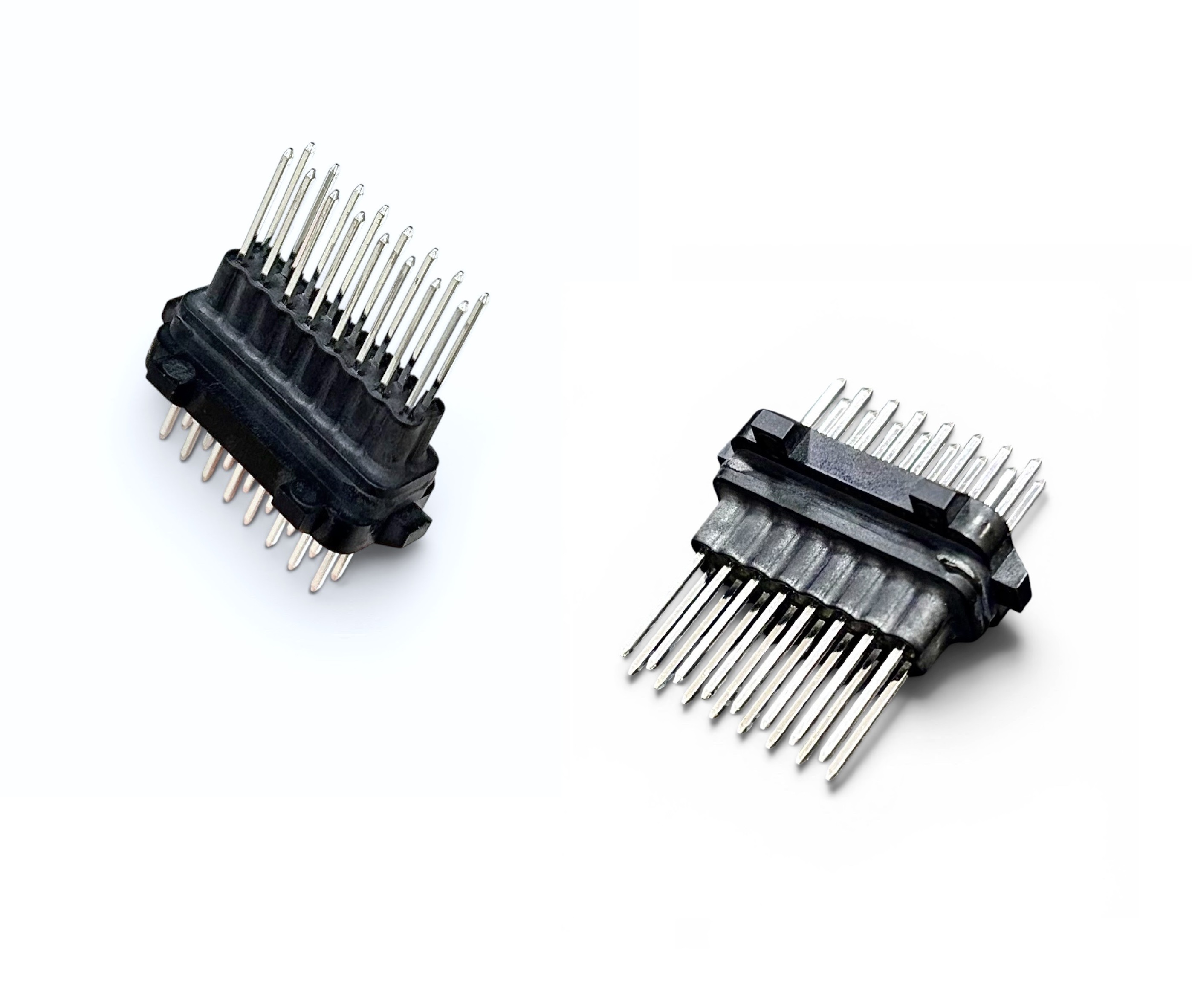
Insert molding is widely used to integrate metal terminals, pins, busbars, bushings, sensors, electronic components, and other inserts directly into plastic parts. In simple applications, a metal insert can be placed into a mold and encapsulated in a single injection molding cycle.
However, many high-precision insert molding applications require a more controlled two-stage process:
- First-shot molding, also called pre-molding
- Second-shot molding, also called overmolding
The first shot creates a stable pre-molded insert or subcomponent around selected areas of the metal insert. The pre-molded component is then transferred to another mold, where the second plastic material is injected to complete the final geometry.
Although this additional step increases tooling and process complexity, it often provides significantly better dimensional stability, insulation performance, sealing reliability, insert positioning, and molding consistency.
This article explains why first-shot pre-molding is important, when it is required, and how it improves the quality of the final overmolded component.
What Is First-Shot Pre-Molding?
First-shot pre-molding is the initial injection molding process used to partially encapsulate, support, position, insulate, or mechanically lock a metal insert before the final overmolding operation.
The first-shot molded component may include:
- Metal terminals
- Connector pins
- Lead frames
- Busbars
- Stamped metal parts
- Sensor elements
- Threaded inserts
- Conductive components
- Electronic subassemblies
During the first shot, plastic is molded only around selected areas of the insert. The resulting pre-molded insert becomes a more stable and accurately defined component that can be placed into the second-shot mold.
The second-shot overmolding process then forms the final housing, sealing structure, connector body, mounting features, or external geometry.
In technical terms, the complete sequence may be described as:
Metal Insert → First-Shot Pre-Molding → Pre-Molded Insert → Second-Shot Overmolding → Finished Component
This process is common in automotive connectors, power electronics, industrial sensors, medical devices, motor components, waterproof connectors, and other applications that require high dimensional and functional reliability.
Is Pre-Molding Always Required for Insert Molding?
No. Not every insert molding project requires a separate first-shot pre-molding process.
A direct one-step insert molding process may be sufficient when:
- The metal insert is rigid and structurally stable.
- The insert can be accurately located by the mold.
- The insert is not easily displaced by injection pressure.
- The final geometry is relatively simple.
- Flash around the metal insert is acceptable or easy to control.
- The product does not require complex sealing or electrical insulation.
- The number of pins or terminals is limited.
- The dimensional tolerances are not extremely tight.
However, first-shot pre-molding becomes much more important when the product contains multiple thin terminals, long unsupported pins, delicate lead frames, complex sealing paths, tight pin-position tolerances, thin plastic walls, or multiple functional materials.
The decision should therefore be made during DFM, mold design, Moldflow analysis, insert tolerance analysis, and process risk evaluation.
Why Is the First Shot So Important?
1. It Stabilizes and Positions Metal Inserts
One of the greatest challenges in insert molding is maintaining the exact position of the metal insert during injection.
Molten plastic enters the cavity at high speed and pressure. Thin terminals, long pins, stamped parts, or delicate lead frames may bend, vibrate, shift, or lift during filling.
Even a small displacement can cause:
- Incorrect pin pitch
- Poor terminal alignment
- Uneven plastic wall thickness
- Electrical contact problems
- Assembly interference
- Leakage
- Short shots
- Exposed metal
- Terminal deformation
The first-shot plastic acts as a rigid support structure. It locks multiple pins or terminals together and converts a flexible metal insert into a stable pre-molded assembly.
This is particularly important for connectors with many closely spaced pins. Instead of individually controlling every pin during the second shot, the second mold locates the more rigid pre-molded body.
As a result, the second-shot overmolding process becomes more repeatable and less sensitive to insert variation.
2. It Reduces Insert Movement During High-Pressure Overmolding
Injection pressure can generate significant force on exposed metal surfaces.
The actual force depends on:
- Melt pressure
- Projected insert area
- Gate position
- Flow direction
- Filling speed
- Material viscosity
- Insert geometry
- Mold support conditions
If the metal insert is unsupported, the polymer flow may push it away from its intended position.
A first-shot pre-mold provides additional support and creates larger, more stable locating surfaces. The second-shot mold can clamp and locate the pre-molded plastic instead of relying only on narrow metal pins.
This reduces the risk of:
- Insert floating
- Insert shifting
- Terminal bending
- Pin deformation
- Insert rotation
- Uneven encapsulation
- Dimensional instability
For high-cavitation production molds, this stability is essential because every cavity must position the insert consistently over millions of molding cycles.
3. It Improves Pin Pitch and Terminal Alignment
In electrical connectors, the position of every terminal must remain within a defined tolerance.
If a connector contains 10, 20, 30, or more pins, controlling every terminal independently becomes difficult. Stamping tolerances, carrier deformation, handling, cutting, transfer, and molding pressure can all affect the final pin position.
The first shot can establish critical relationships between the terminals before the final housing is molded.
It can control:
- Pin-to-pin pitch
- Terminal height
- Coplanarity
- Perpendicularity
- Terminal exposure length
- Electrical isolation distance
- Position relative to datum features
The pre-molded insert can also provide plastic reference surfaces for automatic handling, camera inspection, and second-shot mold loading.
This makes the entire production process more suitable for automation.
4. It Creates Reliable Electrical Insulation
Many insert-molded products contain conductive metal terminals that must remain electrically isolated from each other.
The first-shot plastic can be designed to create controlled insulation barriers between adjacent terminals.
These barriers help maintain:
- Creepage distance
- Clearance distance
- Dielectric strength
- Insulation resistance
- Terminal separation
- Protection against electrical tracking
Without a pre-molding stage, the second-shot melt may not reliably flow into very small spaces between closely positioned terminals. Air traps, weld lines, short shots, or thin insulation walls may occur.
A dedicated first-shot mold can fill these critical insulation areas under more controlled conditions.
This is especially important for:
- Power connectors
- Automotive high-voltage components
- Busbar assemblies
- Power module housings
- Battery systems
- Industrial control components
- Motor terminals
- Inverter components
The first shot may therefore perform an electrical function, not merely a mechanical one.
5. It Helps Control Flash Around Terminals
Flash is one of the most common quality challenges in insert molding.
When metal terminals pass through the mold parting surface, the mold must seal directly against the metal. Any variation in terminal thickness, flatness, coating, burr height, or position may create a small gap.
Under injection pressure, molten plastic can enter this gap and form flash.
Terminal flash may cause serious problems, including:
- Poor electrical contact
- Assembly interference
- Connector mating failure
- Cosmetic defects
- Leakage paths
- Manual trimming requirements
- Contamination of functional surfaces
During first-shot pre-molding, critical sealing areas can be formed under controlled mold conditions. The pre-molded plastic can then provide a more stable and consistent shut-off surface for the second mold.
Compared with sealing directly against multiple thin metal terminals, sealing against a dimensionally controlled plastic preform is often more reliable.
This can significantly reduce second-shot flash risk.
6. It Protects Delicate Inserts During the Second Shot
Some inserts are too fragile to withstand direct exposure to the second-shot molding pressure and temperature.
Examples include:
- Thin stamped terminals
- Fine lead frames
- Small sensor elements
- Flexible conductive components
- Small electronic assemblies
- Coated terminals
- Plated metal parts
- Wire or cable terminations
The first shot can encapsulate and protect vulnerable areas before the higher-volume second-shot material is injected.
It may also prevent polymer flow from directly impacting a critical surface.
By controlling the location of the first-shot gate, engineers can direct the initial melt flow toward stronger insert areas. The protected pre-molded component can then safely withstand the second overmolding process.
7. It Creates Mechanical Interlocking Features
A successful overmolding process must resist separation between the first-shot component and the second-shot material.
The first-shot preform can include specially designed mechanical interlocking features, such as:
- Undercuts
- Through-holes
- Grooves
- Ribs
- Knurl-like surfaces
- Anchoring pockets
- Dovetail structures
- Flow-through windows
During second-shot overmolding, molten plastic flows into or around these structures and forms a mechanical lock.
This is particularly important when:
- The two plastic materials have limited chemical compatibility.
- The first-shot surface has cooled completely.
- The component experiences vibration or thermal cycling.
- The product requires high pull-out strength.
- The interface is exposed to moisture or chemicals.
- The overmolded section is subjected to bending or torque.
A strong mechanical interlock reduces dependence on chemical adhesion alone.
8. It Improves Sealing and Leak Resistance
For waterproof connectors, sensor housings, fluid-control components, and automotive applications, the interface between metal and plastic must prevent the passage of water, oil, air, gas, or other fluids.
Metal inserts often have microscopic surface irregularities. Plating variation, stamping marks, burrs, and dimensional variation may create leakage paths.
A controlled first-shot process can encapsulate the most critical metal-to-plastic sealing interface before the final housing is formed.
The second shot then encapsulates the pre-molded structure and creates an additional sealing layer.
This two-stage structure can provide:
- A longer leakage path
- Multiple sealing interfaces
- Improved metal encapsulation
- Better control of plastic wall thickness
- Reduced risk of voids
- Better protection from moisture penetration
However, leak performance still depends on product geometry, metal surface condition, resin selection, mold venting, gate design, process conditions, and thermal expansion differences.
Pre-molding improves sealing potential, but it must be combined with proper design and validation.
9. It Allows Different Materials to Perform Different Functions
The first-shot and second-shot materials do not always need to be identical.
A two-stage insert molding process allows engineers to select materials according to different functional requirements.
For example, the first-shot material may be selected for:
- High flow
- Precise filling around small terminals
- Strong metal adhesion
- High dielectric strength
- High-temperature resistance
- Dimensional stability
- Low shrinkage
The second-shot material may be selected for:
- Impact resistance
- Chemical resistance
- External appearance
- Sealing performance
- Structural strength
- Flame resistance
- Cost efficiency
- Environmental durability
Possible engineering materials include:
- PBT
- PA66
- PA6
- PPA
- PPS
- LCP
- PEI
- PEEK
- TPE
- TPU
- Silicone or LSR in suitable applications
Material compatibility must be evaluated carefully. The design team should consider processing temperature, shrinkage, bonding behavior, moisture absorption, thermal expansion, chemical compatibility, and long-term aging.
10. It Separates Critical Molding Functions
A single-shot mold may be required to perform too many difficult tasks at the same time:
- Position multiple terminals
- Seal around metal surfaces
- Fill thin insulation walls
- Form the external housing
- Prevent terminal movement
- Avoid weld lines
- Control warpage
- Maintain cosmetic quality
- Achieve leak resistance
Separating the product into first-shot and second-shot molding stages allows each mold to focus on a more specific function.
The first-shot mold can concentrate on:
- Insert positioning
- Terminal insulation
- Critical metal sealing
- Pin alignment
- Small precision features
The second-shot mold can concentrate on:
- Final housing geometry
- Structural features
- Mounting interfaces
- External sealing
- Cosmetic surfaces
- Assembly features
This separation can simplify process optimization and reduce the number of conflicting molding requirements within a single mold.
How First-Shot Pre-Molding Improves Second-Shot Overmolding
A well-designed pre-molded insert gives the second-shot mold a stable and repeatable input component.
The second-shot process benefits from:
| Second-Shot Requirement | Contribution of First-Shot Pre-Molding |
|---|---|
| Accurate insert loading | Creates larger and more stable locating surfaces |
| Pin alignment | Locks terminals into a controlled position |
| Reduced flash | Provides consistent plastic shut-off areas |
| Stable filling | Prevents metal inserts from moving under melt pressure |
| Better sealing | Encapsulates critical metal interfaces |
| Improved insulation | Forms controlled barriers between terminals |
| Automated loading | Provides grippable and detectable reference features |
| Lower rejection rate | Reduces insert-related process variation |
| Better cavity consistency | Standardizes the insert condition before overmolding |
| Improved traceability | Allows inspection between the first and second shots |
The first shot should therefore be viewed as a functional precision component, rather than simply an unfinished plastic part.
Key Design Considerations for First-Shot Pre-Molding
Insert Locating and Mold Datum Strategy
The pre-mold must establish clear and repeatable datums.
The design should identify:
- Primary locating surfaces
- Secondary locating surfaces
- Terminal support points
- Anti-rotation features
- Insert loading direction
- Mold clamping direction
- Transfer references for the second shot
Metal inserts should not be over-constrained, especially when the stamping or machining tolerance is relatively large. Excessive constraint may cause loading difficulty, deformation, or mold damage.
Plastic Shut-Off Design
Shut-off areas around the metal insert must be designed carefully.
Important factors include:
- Terminal thickness tolerance
- Metal burr direction
- Plating thickness
- Insert flatness
- Mold steel contact pressure
- Shut-off angle
- Wear resistance
- Insert loading repeatability
Critical shut-off surfaces may require hardened mold steel, replaceable inserts, and high-precision machining.
Gate Location and Flow Direction
The first-shot gate should be positioned to minimize insert movement.
Whenever possible, the melt flow should:
- Push the insert toward a supported surface.
- Avoid direct impact on thin terminals.
- Fill critical insulation areas before freezing.
- Reduce weld lines in sealing regions.
- Avoid trapping air between adjacent terminals.
- Maintain balanced filling in multi-cavity molds.
Moldflow analysis can help evaluate pressure distribution, flow balance, air traps, weld lines, and potential insert displacement.
However, physical mold trials are still necessary because the actual behavior also depends on insert stiffness, mold support, surface condition, and process settings.
First-Shot and Second-Shot Interface Design
The interface between the first-shot and second-shot materials must support both molding and long-term product performance.
The design should consider:
- Mechanical interlocking
- Material compatibility
- Surface contamination
- Preform storage time
- Moisture absorption
- Preheating requirements
- Interface temperature
- Shrinkage differences
- Thermal expansion
- Long-term delamination risk
If strong chemical bonding cannot be guaranteed, mechanical locking features should be included.
Dimensional Compensation
The first-shot component will shrink after molding. It may then be reheated during the second-shot process and experience additional stress or dimensional change.
Engineers must therefore consider:
- First-shot shrinkage
- Second-shot reheating
- Differential shrinkage
- Insert thermal expansion
- Residual stress
- Warpage after final cooling
- Cavity-to-cavity variation
The final mold dimensions cannot always be determined by simply applying a standard resin shrinkage percentage. Prototype trials and dimensional correlation are often required.
Common Problems When the First Shot Is Poorly Designed
An unstable or inaccurate first-shot component can transfer its defects directly into the second-shot process.
Typical problems include:
Pre-Mold Flash
Flash on the first-shot component may prevent proper seating in the second-shot cavity. This can create mold interference, incorrect dimensions, additional flash, or mold damage.
Pre-Mold Warpage
If the pre-molded insert is warped, the second mold may force it into position during closing. This introduces stress and may cause terminal movement, cracking, or dimensional recovery after molding.
Incorrect Terminal Position
The second shot cannot reliably correct a terminal that was already positioned incorrectly during the first shot.
Contaminated Bonding Surface
Oil, dust, release agents, oxidation, moisture, and handling contamination can reduce adhesion between the first-shot and second-shot materials.
Insufficient Mechanical Lock
Without proper interlocking features, the second-shot material may separate from the pre-molded component during thermal cycling, vibration, or mechanical loading.
Improper First-Shot Material Selection
The first-shot material must tolerate the temperature and pressure of the second-shot process. If its heat resistance is insufficient, it may soften, deform, or lose dimensional accuracy.
Quality Control Between the First and Second Shots
One major advantage of a two-stage process is the ability to inspect the pre-molded insert before final overmolding.
Possible inspection items include:
- Terminal position
- Pin pitch
- Terminal height
- Coplanarity
- Insert orientation
- Plastic flash
- Short shots
- Cracks
- Contamination
- Critical pre-mold dimensions
- Electrical continuity
- Insulation resistance
- Vision-system inspection
Rejecting a defective pre-mold before the second shot prevents additional material, machine time, and processing costs from being added to a nonconforming component.
For automated production, cavity identification and traceability can also be incorporated into the first-shot component.
When Should a Two-Stage Insert Molding Process Be Considered?
First-shot pre-molding followed by second-shot overmolding should be evaluated when the product includes one or more of the following conditions:
- Multiple precision terminals
- Long or easily deformed pins
- Tight pin-position tolerances
- High-pressure overmolding
- Thin insulation walls
- Complex electrical isolation requirements
- Waterproof or leak-resistant construction
- High-voltage creepage and clearance requirements
- Delicate sensors or electronic inserts
- Complex metal-plastic interfaces
- Different functional plastic materials
- Automated insert handling
- High production volumes
- Strict automotive or industrial quality requirements
- Critical dimensional relationships between multiple inserts
The final decision should be based on total manufacturing risk, not only on mold cost.
A one-shot tool may appear less expensive initially. However, if it produces unstable insert positioning, terminal flash, leakage, deformation, or a high rejection rate, the total production cost may become much higher.
One-Shot Insert Molding vs. Pre-Molding and Overmolding
| Item | Direct One-Shot Insert Molding | First-Shot Pre-Molding + Second-Shot Overmolding |
|---|---|---|
| Tooling investment | Lower | Higher |
| Process steps | Fewer | More |
| Cycle handling | Simpler | Requires transfer or automation |
| Insert positioning | Depends heavily on mold support | More stable after pre-molding |
| Multi-pin control | More difficult | Easier to control |
| Flash control | May be difficult around metal | Improved with pre-molded shut-off surfaces |
| Material flexibility | Usually one plastic material | Different materials can be used |
| Electrical insulation | Limited by single filling process | Critical insulation can be formed separately |
| Leak resistance | Design-dependent | Additional sealing structures are possible |
| Automation potential | Good for simple inserts | Strong for complex, high-volume assemblies |
| Suitable applications | Simple and rigid inserts | Complex, precise, high-reliability components |
The two-stage process is not automatically better for every product. It becomes valuable when it reduces technical risk and improves repeatability enough to justify the additional mold and manufacturing steps.
Conclusion: The First Shot Determines the Stability of the Final Overmolded Product
In advanced insert molding, the quality of the final component often depends on the quality of the first-shot pre-molding process.
The first shot performs several essential functions:
- It accurately positions and supports metal inserts.
- It prevents pin movement during second-shot injection.
- It improves terminal alignment and dimensional consistency.
- It creates controlled electrical insulation.
- It reduces flash around metal terminals.
- It protects delicate inserts.
- It provides mechanical interlocking features.
- It improves sealing and leak resistance.
- It supports automated handling and inspection.
- It creates a stable foundation for second-shot overmolding.
For connectors, sensors, busbars, power electronics, automotive components, and other high-reliability products, first-shot pre-molding should not be viewed as an unnecessary extra process.
It is often the most important step for transforming a flexible or dimensionally unstable metal insert into a consistent, moldable, and production-ready subassembly.
At Ming-Li Precision, the first-shot mold, second-shot mold, metal insert, material selection, molding parameters, automation, and quality-control strategy are evaluated as one integrated manufacturing system.
By understanding both precision mold engineering and insert molding production, Ming-Li helps customers develop stable and scalable overmolding solutions from DFM and tooling through mass production and final inspection.