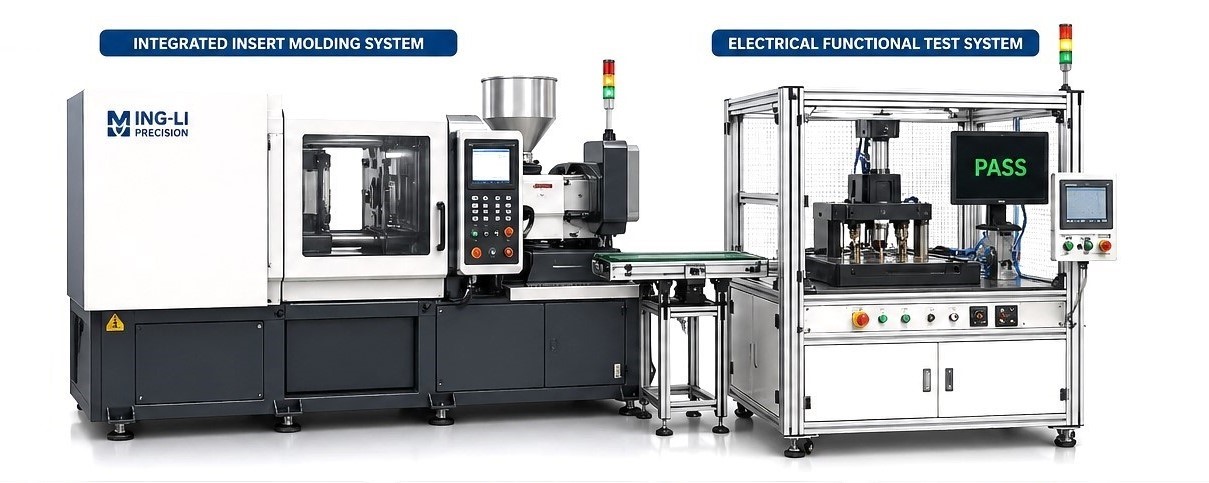
Electrical Functional Testing
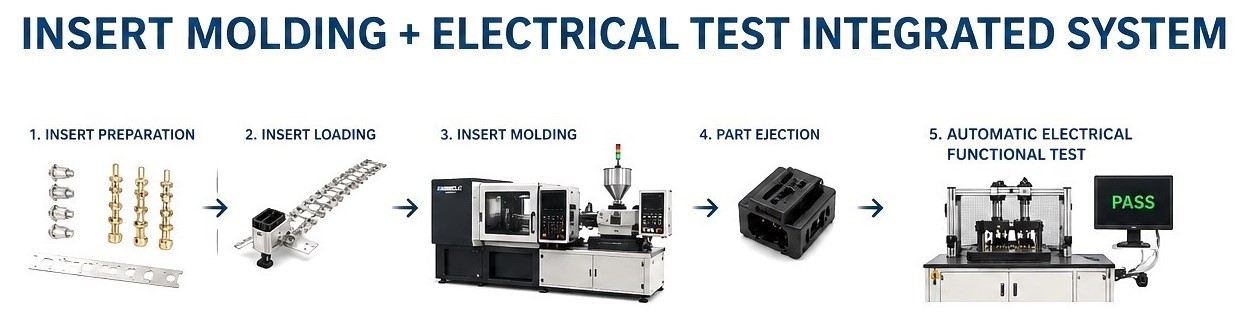
Electrical Functional Testing (FCT): The Final Frontier of Quality Assurance in Mechatronic Integration
In the production of high-complexity mechatronic assemblies—such as automotive power modules and integrated connector systems—mechanical precision is only half of the requirement. The final product must perform its intended electrical duties under real-world conditions. Electrical Functional Testing (FCT) is the critical final stage of the manufacturing process, providing a comprehensive "go/no-go" validation that the integrated assembly, including its PCBs and molded components, operates exactly as designed.
What is an Electrical Functional Tester?
An Electrical Functional Tester is a specialized system designed to simulate the final operating environment of a device. Unlike In-Circuit Testing (ICT), which checks individual components on a PCB, FCT tests the entire system’s functionality. It verifies that the signals, power distribution, and communication protocols (such as CAN or LIN) are functioning correctly after the components have been integrated via insert molding or mechanical assembly.
Core Components of an FCT System
To achieve high-throughput and high-reliability testing, an FCT system utilizes several key technologies:
-
The Test Fixture (Bed of Nails): A custom-engineered interface using precision-aligned pogo pins that make contact with specific test points on the assembly without damaging the surface.
-
Signal Simulation & Measurement: The system injects specific inputs (voltages, frequencies, or data packets) and measures the resulting outputs to ensure they fall within the specified tolerances.
-
Software Logic: Advanced test sequences allow for the automation of complex procedures, logging data for every unit produced to ensure full traceability.
The Critical Role in Mechatronic Assemblies
For manufacturers providing Total Engineering Solutions, FCT is indispensable when dealing with multi-material integration:
-
Validating Overmolded Electronics: The high pressures and temperatures of the overmolding process can occasionally stress solder joints or shift internal components. FCT detects these "invisible" failures that a visual or dimensional inspection might miss.
-
Power Module Verification (IGBT/SiC): In high-power electronics, FCT ensures that power modules can handle specified currents and voltages ($P = V \times I$) without thermal runaway or insulation breakdown.
-
Connector Integrity: For large-scale connector integration, the tester verifies continuity and insulation resistance across all pins, ensuring there are no internal shorts caused by the molding process.
Technical Parameters Tested
-
Continuity and Isolation: Ensuring electrical paths are complete and that there is no leakage between high-voltage and low-voltage circuits.
-
Voltage Drop and Power Consumption: Verifying that the device operates efficiently within its power budget.
-
Communication Protocol Testing: Checking that the integrated PCB correctly sends and receives data through its connectors.
-
Sensor Calibration: For assemblies with integrated sensors, the FCT can calibrate and verify the accuracy of the output signal.
Strategic Importance for Tier 1 Suppliers
Integrating Electrical Functional Testing into the production line offers several strategic advantages:
-
Zero-Defect Delivery: It prevents faulty units from reaching the end-user, protecting the manufacturer’s reputation and reducing the costs associated with field failures or recalls.
-
Process Feedback: If a specific functional failure appears repeatedly, it provides immediate feedback to the injection molding or PCB assembly teams to optimize their parameters.
-
Traceability and Compliance: Every test result is recorded, providing the rigorous documentation required for automotive (IATF 16949), aerospace, and medical standards.
As automotive and industrial components become more "intelligent," the line between mechanical housing and electronic circuitry continues to blur. By combining precision insert molding and 5-axis machining with robust Electrical Functional Testing, manufacturers can offer a complete, verified solution. This integrated approach ensures that complex parts—from PEEK stator rings for space agencies to high-power semiconductor housings—are not only dimensionally perfect but functionally flawless.
Electrical Functional Tester: Ming-Li Precision’s Capability in Custom Test Equipment Development
Introduction
As modern products become increasingly integrated with electronics, ensuring functional performance is just as critical as dimensional accuracy. For components such as connectors, sensor housings, and insert-molded electronic assemblies, electrical functionality testing is essential to verify reliability and performance.
At Ming-Li Precision Steel Molds Co., Ltd., quality assurance goes beyond traditional inspection. Leveraging its engineering expertise, Ming-Li provides the capability to design and manufacture customized Electrical Functional Testers (EFT) tailored to customer-specific applications.
What is an Electrical Functional Tester?
An Electrical Functional Tester (EFT) is a system used to verify whether a product or component performs its intended electrical function under defined conditions.
Typical testing functions include:
- Continuity testing
- Resistance measurement
- Voltage and current verification
- Signal transmission testing
- Insulation and leakage testing
These tests ensure that the product meets both functional and safety requirements.
Ming-Li Precision’s Custom Electrical Testing Capability
Unlike standard equipment suppliers, Ming-Li Precision offers a fully customized approach, integrating:
- Mechanical design
- Fixture and jig development
- Electrical testing integration
- Automation and production compatibility
This enables the creation of tailor-made testing solutions that match the exact requirements of each project.
Key Advantages of Ming-Li’s Electrical Functional Tester Solutions
1. Custom Design Based on Product Requirements
Ming-Li works closely with customers to develop testers that:
- Match part geometry and design
- Integrate seamlessly into production lines
- Meet specific electrical test criteria
This ensures 100% alignment with real application needs.
2. Integration with Insert Molding and Assembly
With strong expertise in:
- Insert molding (metal + plastic + electronics)
- Connector and electronic component manufacturing
Ming-Li can design testers that:
✔ Verify electrical performance immediately after molding or assembly
✔ Reduce risk of defective products reaching customers
3. Fixture and Jig Precision Manufacturing
Leveraging ultra-precision tooling capability, Ming-Li provides:
- High-accuracy test fixtures
- Stable contact interfaces
- Long-term durability for mass production
This ensures:
✔ Reliable electrical contact
✔ Consistent measurement results
4. Automation-Ready Testing Systems
Ming-Li can develop testers that:
- Integrate with automated assembly lines
- Support high-volume production
- Enable fast and repeatable testing cycles
This improves:
✔ Production efficiency
✔ Quality consistency
5. Data Collection and Traceability
Custom test systems can include:
- Data logging and storage
- Pass/fail classification
- Integration with MES or SPC systems
This enables:
✔ Full traceability
✔ Data-driven quality control
Applications at Ming-Li Precision
Ming-Li’s Electrical Functional Tester solutions are suitable for:
• Connector and Terminal Testing
- Continuity and resistance verification
- Contact reliability testing
• Insert Molded Electronic Components
- Verifying electrical paths after molding
- Ensuring proper integration of metal inserts and circuits
• Sensor and Electronic Module Testing
- Signal validation
- Functional performance testing
• Power Module Components
- Electrical integrity verification
- Ensuring safe and reliable operation
Why Electrical Functional Testing Matters
Electrical defects can lead to:
- Product failure in the field
- Safety risks
- High warranty costs
By implementing customized electrical testing solutions, Ming-Li Precision ensures:
✔ Reliable product performance
✔ Early defect detection
✔ Improved manufacturing yield
✔ Reduced customer risk
Ming-Li Precision’s Engineering Strength
Ming-Li Precision combines:
- Precision mold manufacturing
- Injection molding and insert molding expertise
- Assembly and automation capability
- Custom test equipment development
This unique combination enables Ming-Li to provide a Total Engineering Solution, from product design to final functional verification.
Conclusion
The ability to develop custom Electrical Functional Testers sets Ming-Li Precision apart from traditional mold makers.
By integrating testing directly into the manufacturing process, Ming-Li helps customers achieve:
- Higher quality
- Greater reliability
- More efficient production
Contact Ming-Li Precision
If your project involves:
- Electronic components
- Insert molding with electrical functionality
- Custom testing requirements
Ming-Li Precision can support not only manufacturing, but also the development of customized testing solutions tailored to your needs.