
Hardness Testing
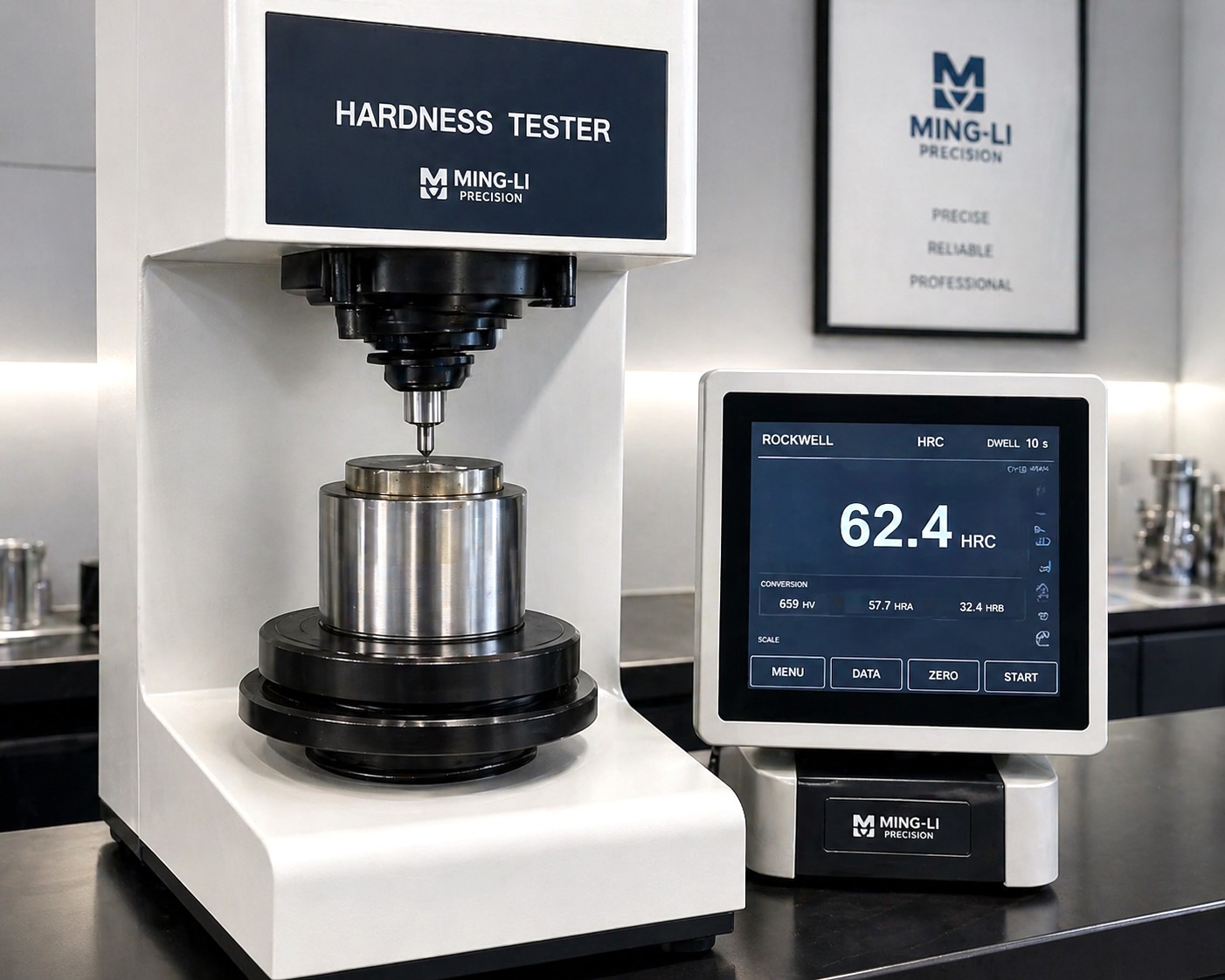
Ensuring Tooling Longevity: A Technical Overview of Mold Steel Hardness Testing
In the world of ultra-precision injection molding, the mold is the heart of the production process. While dimensional accuracy is achieved through advanced 5-axis CNC machining, the durability and wear resistance of the tool are determined by the mechanical properties of the mold steel. Hardness Testing is the primary method used to verify that tool steel has been correctly heat-treated to survive the thermal and mechanical stresses of high-volume manufacturing.
The Definition of Hardness in Tooling
In a metallurgical context, hardness is defined as a material's resistance to localized plastic deformation, typically induced by mechanical indentation or abrasion. For mold steels like NAK80, H13 (SKD61), or S136, hardness is a proxy for tensile strength and wear resistance—critical factors when processing abrasive resins such as glass-filled PBT or LCP.
Primary Testing Methodologies
1. Rockwell Hardness Test (HRC/HRB)
The Rockwell test is the most common method for evaluating mold steel due to its speed and direct-reading capability. For hardened tool steels, the Rockwell C (HRC) scale is used.
-
Process: A diamond cone indenter is pressed into the steel with a minor load, followed by a major load. The "permanent increase in depth of penetration" is measured.
-
Application: Standard for verifying the core and surface hardness of mold bases and inserts.
2. Vickers Hardness Test (HV)
The Vickers test uses a square-based diamond pyramid indenter. It is highly precise and can be used across a wide range of materials.
-
Formula: The Vickers Number (HV) is calculated based on the load (F) and the arithmetic mean of the two diagonals (d) of the indentation:
-
Application: Ideal for measuring thin surface layers, such as nitriding or specialized coatings used to protect gates from erosion.
3. Brinell Hardness Test (HB)
This method uses a hardened steel or carbide ball indenter.
-
Application: Typically used for raw material inspection of unhardened steel blocks or large castings where a larger indentation provides a more representative average of the material's structure.
Hardness Comparison of Common Mold Steels
| Steel Grade | Type | Typical Hardness (HRC) | Primary Application |
| NAK80 | Pre-hardened | 37 – 43 | High-polish mirrors, transparent parts |
| H13 (SKD61) | Through-hardened | 48 – 52 | High-temp/high-pressure injection |
| S136 | Stainless | 48 – 54 | Medical/Corrosive resins (PVC/PFA) |
| DC53 | Cold-work | 60 – 62 | High-wear inserts and sliders |
The Strategic Importance of Validation
-
Heat Treatment Verification: Hardness testing is the only way to confirm that the quenching and tempering cycles have reached the required specification. If the steel is too soft, the mold will deform; if it is too brittle ($HRC$ too high), it may crack under injection pressure.
-
Wear Resistance for Abrasive Materials: High-performance polymers often contain glass fibers that act like sandpaper. A mold with verified hardness ensures the gate and cavity geometry remain within tolerance over millions of cycles.
-
Predicting Machinability: In a precision 5-axis environment, knowing the exact hardness of the workpiece allows for the optimization of spindle speeds and feed rates, preventing premature tool wear or breakage on the CNC machine.
Technical Note: While high hardness increases wear resistance, it generally decreases toughness. Engineers must find the "Sweet Spot"—the optimal hardness level that provides maximum tool life without risking structural failure of the mold during operation.
Integrating rigorous hardness testing into the Total Engineering workflow provides a scientific guarantee of tool performance. By validating the material properties of the mold steel before production begins, manufacturers can ensure that complex components—from IGBT power module housings to aerospace insulators—are produced with consistent quality from the first shot to the last.
Hardness Test: Ming-Li Precision’s Capability for Accurate Material Hardness Evaluation
Introduction
In precision manufacturing, material performance is just as critical as dimensional accuracy. Among key material properties, hardness plays a vital role in determining wear resistance, strength, durability, and product lifespan.
At Ming-Li Precision Steel Molds Co., Ltd., comprehensive quality assurance includes advanced hardness testing capability, enabling accurate evaluation of metal components, mold materials, and critical parts to ensure they meet stringent performance requirements.
What is a Hardness Test?
A Hardness Test measures a material’s resistance to deformation, typically by applying a controlled force using a standardized indenter.
Common hardness testing methods include:
- Rockwell (HRC / HRB)
- Vickers (HV)
- Brinell (HB)
These methods provide quantitative values that indicate:
- Material strength
- Heat treatment effectiveness
- Wear resistance
Ming-Li Precision’s Hardness Testing Capability
Ming-Li Precision is equipped with industrial hardness testing machines that provide:
- Accurate and repeatable hardness measurements
- Multi-scale testing capability (HRC, HV, etc.)
- Reliable data for material validation and quality control
This ensures that every component meets required specifications before and after manufacturing processes.
Key Features and Advantages
1. High Accuracy and Repeatability
Hardness testing systems at Ming-Li deliver:
- Stable indentation force control
- Precise measurement of hardness values
- Consistent results across multiple tests
This guarantees reliable verification of material properties.
2. Support for Multiple Hardness Standards
Ming-Li can perform:
✔ Rockwell hardness testing (HRC / HRB)
✔ Vickers hardness testing (HV)
✔ Conversion between hardness scales
This flexibility allows testing based on customer requirements and international standards.
3. Verification of Heat Treatment Quality
Hardness testing is essential for:
- Confirming proper heat treatment
- Ensuring required hardness levels are achieved
- Preventing under- or over-hardening
This is particularly important for mold steel and wear-critical components.
4. Detection of Material Inconsistencies
Hardness testing helps identify:
- Material defects
- Improper processing
- Variations in material composition
This ensures only qualified materials are used in production.
5. Integration with Quality Control Process
Hardness measurement at Ming-Li is applied in:
- Incoming material inspection
- In-process quality control
- Final product validation
This provides full traceability and consistent quality assurance.
Applications at Ming-Li Precision
• Mold Steel Inspection
- Verifying hardness of core, cavity, and inserts
- Ensuring durability and wear resistance
• Heat-Treated Components
- Confirming hardness after heat treatment
- Ensuring performance meets design requirements
• Precision Mechanical Parts
- Checking hardness consistency
- Preventing premature failure
• Quality Assurance for Critical Components
- Ensuring compliance with customer specifications
- Supporting high-reliability applications
Why Hardness Testing Matters
Material hardness directly affects:
- Wear resistance and tool life
- Mechanical strength
- Dimensional stability
- Product reliability
By performing hardness testing, Ming-Li Precision ensures:
✔ Consistent material quality
✔ Reliable product performance
✔ Reduced risk of failure
✔ Compliance with strict specifications
Ming-Li Precision’s Quality Commitment
With advanced inspection and testing capabilities including:
- ZEISS CMM systems
- Optical measurement systems
- Surface roughness testers
- Roundness and form measurement systems
- Material testing (MFR, moisture, density)
- Hardness testing
Ming-Li Precision delivers:
- Comprehensive material-to-product quality control
- Data-driven manufacturing processes
- High reliability for precision components
Combined with expertise in insert molding, 2K molding, and ultra-precision tooling, Ming-Li provides a complete Total Engineering Solution.
Conclusion
Hardness testing is a critical step in ensuring material performance and product reliability. With advanced hardness testing equipment and strong engineering expertise, Ming-Li Precision provides accurate and reliable hardness evaluation to support high-quality manufacturing.
Contact Ming-Li Precision
If your project requires:
- Material property verification
- High-precision mold manufacturing
- Reliable injection molding solutions
Ming-Li Precision is your trusted partner for precision and quality.