
CNC Double Flank Gear Rolling Testing
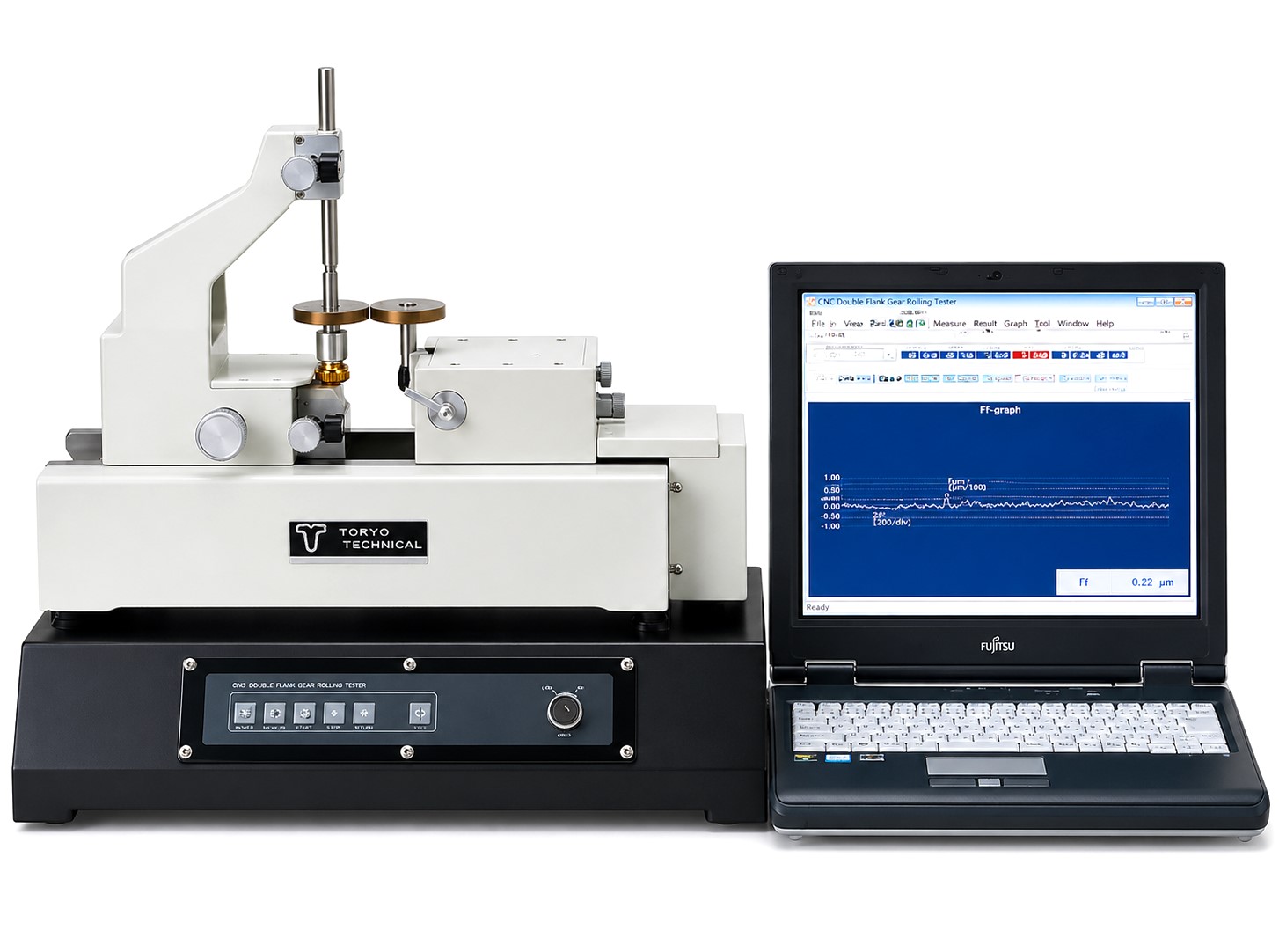
Precision in Motion: An Introduction to CNC Double Flank Gear Rolling Testing
In the world of high-performance transmission systems—from the silent actuators in medical devices to the high-torque gearboxes of Electric Vehicles (EVs)—the precision of gear geometry is paramount. While single-flank testing simulates real-world functional operation, the CNC Double Flank Gear Rolling Tester serves as the definitive high-speed diagnostic tool for identifying manufacturing deviations. It provides a composite evaluation of gear quality, ensuring that every tooth profile meets the rigorous demands of modern mechatronic assemblies.
The Fundamental Principle: Double Flank Mesh
The double flank test, often referred to as a Radial Composite Test, involves meshing a production gear with a high-precision "Master Gear."
-
The Mechanism: The gears are held in tight mesh under spring tension so that there is zero backlash (both flanks of the gear teeth are in contact simultaneously).
-
Measurement: As the gears rotate $360^\circ$, the floating axis of the tester moves in and out to accommodate errors in the production gear. The CNC system tracks the variation in Center Distance with sub-micron resolution.
Key Metrology Parameters
A CNC Double Flank tester translates physical motion into a radial composite trace, allowing engineers to quantify several critical errors:
-
Total Radial Composite Deviation (Fi''): The total variation in center distance over one full revolution. This indicates the overall quality and "runout" of the gear.
-
Tooth-to-Tooth Radial Composite Deviation (fi''): The maximum variation occurring over a single tooth pitch (360^\circ/z). This is a key indicator of surface finish and individual profile errors.
-
Radial Runout (Fr): The eccentricity of the pitch circle relative to the bore or shaft axis.
-
Nick/Burr Detection: The high sensitivity of CNC sensors allows for the immediate identification of localized "nicks" that would cause noise or vibration in the final assembly.
The CNC Advantage: Speed and Data Integrity
Traditional manual rolling testers relied on analog gauges and operator feel. Modern CNC-driven systems bring several transformative advantages:
-
Automated Cycle Control: Precise control over rotational speed and measuring pressure ensures that data is repeatable across different operators.
-
Digital Traceability: Every gear tested is logged with a digital profile, supporting IATF 16949 standards and providing a "birth certificate" for critical automotive or aerospace components.
-
Advanced Algorithms: Software can automatically filter out "noise" and calculate complex geometric tolerances in seconds, providing immediate feedback to the machining department.
Strategic Applications in High-Tech Sectors
For facilities focused on Total Engineering Solutions, gear metrology is the final gatekeeper for system performance:
-
Electric Vehicles (EVs) & SiC Power Modules: As internal combustion engines are replaced by silent electric motors, gear noise (NVH - Noise, Vibration, Harshness) becomes a primary concern. Double flank testing ensures that gear sets are matched for whisper-quiet operation.
-
Medical Robotics: Tiny, high-precision gears made from high-performance polymers (like PEEK or LCP) require delicate contact pressure during testing. CNC testers can be tuned to measure these components without deforming the plastic teeth.
-
Aerospace Actuators: In flight-critical systems, where failure is not an option, double flank testing validates that the gear mesh will remain consistent under extreme environmental conditions.
Integrating Metrology with Precision Machining
The true power of the CNC Double Flank Gear Rolling Tester is realized when its data is fed back to the production floor. If the $fi''$ values begin to trend upward, it provides an early warning that the cutting tools on the 5-axis CNC or gear hobbing machines are wearing down. This "closed-loop" approach minimizes scrap and ensures that the precision engineered into the design is successfully realized in the final product.
As mechanical systems become increasingly integrated with electronic controls, the demand for "perfect" gear geometry has never been higher. The CNC Double Flank Gear Rolling Tester is an indispensable tool for any manufacturer committed to excellence, providing the empirical data necessary to guarantee that precision in motion is never compromised.
CNC Double Flank Gear Rolling Tester: Ming-Li Precision’s Tokyo Technical Instruments TF-40NC for Gear Quality Verification
Introduction
For precision gears, dimensional accuracy alone is not enough. Functional performance—such as smooth rotation, transmission accuracy, and noise behavior—depends heavily on the combined effect of multiple gear errors.
At Ming-Li Precision Steel Molds Co., Ltd., advanced metrology ensures not only dimensional precision but also real-world functional performance. Equipped with the Tokyo Technical Instruments TF‑40NC CNC Double Flank Gear Rolling Tester, Ming-Li provides accurate and reliable gear rolling analysis to validate gear quality.
What is a Double Flank Gear Rolling Test?
A Double Flank Gear Rolling Test evaluates gear quality by meshing a test gear with a master gear under controlled conditions and measuring variations in center distance during rotation.
This method captures:
- Total composite error (Fᵢ″)
- Tooth-to-tooth variation
- Runout and eccentricity
- Pitch and profile deviations (combined effect)
Unlike single-parameter measurements, this test reflects actual functional behavior during operation.
Tokyo Technical Instruments TF-40NC: High-Precision Gear Rolling System
The TF-40NC CNC Double Flank Gear Rolling Tester is designed for high-precision gear inspection, offering:
- CNC-controlled measurement for high repeatability
- High-resolution detection of composite gear errors
- Stable and automated testing process
This system is widely used in industries requiring high-performance gears, such as automotive, electronics, and precision machinery.
Key Features and Advantages
1. Functional Gear Evaluation
The TF-40NC simulates real gear meshing conditions, allowing Ming-Li to:
- Evaluate actual gear performance
- Detect functional issues not visible in dimensional inspection
- Ensure smooth and stable gear transmission
2. High Accuracy and Repeatability
With CNC control, the system provides:
✔ Stable measurement conditions
✔ High repeatability
✔ Reliable data for quality assurance
This is essential for both development and mass production.
3. Comprehensive Error Detection
The system can detect:
- Composite gear errors
- Tooth-to-tooth variation
- Gear eccentricity and runout
- Irregular meshing behavior
This enables early identification of potential performance issues.
4. Automated and Efficient Testing
The TF-40NC supports:
- Automated test cycles
- Data recording and analysis
- Efficient inspection for production environments
This improves both inspection speed and consistency.
5. Support for Precision Plastic and Engineering Gears
Ming-Li applies this system to:
- Plastic injection molded gears
- High-performance engineering plastics (PEEK, LCP, PA)
- Micro gears and precision components
Applications at Ming-Li Precision
• Injection Molded Gear Inspection
- Verifying gear accuracy after molding
- Ensuring consistency across cavities
• Micro and Precision Gears
- Evaluating small-module gears
- Ensuring high-precision transmission
• Automotive and Industrial Components
- Ensuring smooth gear operation
- Reducing noise and vibration
• Insert and Multi-Material Gear Components
- Verifying performance of hybrid structures
- Ensuring stable gear engagement
Why Double Flank Testing Matters
Gear defects can lead to:
- Noise and vibration
- Transmission inefficiency
- Premature wear or failure
By using the TF-40NC, Ming-Li Precision ensures:
✔ Real-world gear performance validation
✔ Improved transmission accuracy
✔ Reduced NVH (Noise, Vibration, Harshness)
✔ Higher product reliability
Ming-Li Precision’s Engineering Advantage
Ming-Li Precision combines:
- Ultra-precision mold manufacturing (±1 µm capability)
- Injection molding and micro-molding expertise
- Advanced metrology and testing systems
- Gear manufacturing and validation capability
This enables Ming-Li to provide a Total Engineering Solution, from design to functional verification.
Conclusion
The Tokyo Technical Instruments TF-40NC CNC Double Flank Gear Rolling Tester enables Ming-Li Precision to go beyond dimensional inspection and validate true gear performance.
For customers requiring high-precision, low-noise, and reliable gear solutions, Ming-Li Precision is a trusted partner for both manufacturing and testing.
Contact Ming-Li Precision
If your project involves:
- Precision gears
- High-performance plastic components
- Functional gear testing requirements
Ming-Li Precision is ready to support your project with advanced manufacturing and testing capabilities.