
Profilometer / Surface Roughness Measurement
Surface Excellence: A Technical Guide to Profilometers and Surface Roughness Testing
In high-precision manufacturing, a component’s performance is often dictated by the microscopic landscape of its surface. While dimensional tolerances ensure parts fit together, Surface Roughness determines how they interact—affecting friction, wear resistance, thermal conductivity, and aesthetic quality. The Profilometer (or surface roughness tester) is the essential metrology tool used to quantify these textures with absolute precision.
What is a Profilometer?
A profilometer is an instrument used to measure a surface's profile to determine its roughness, waviness, and finish. These measurements are critical in validating that a manufacturing process—such as 5-axis CNC machining or injection molding—has met the specified engineering requirements.
Measurement Methodologies: Tactile vs. Optical
-
Tactile (Stylus) Profilometry:
-
Mechanism: A diamond-tipped stylus physically traverses the surface of the part. As it moves, the vertical displacement of the stylus is converted into an electrical signal.
-
Best For: Standard industrial components, metal surfaces, and deep grooves where physical contact provides the most reliable data.
-
-
Optical (Non-Contact) Profilometry:
-
Mechanism: Utilizes light (laser or white light interferometry) to scan the surface.
-
Best For: Soft polymers (like PEEK or LCP), delicate medical components, or ultra-smooth surfaces where a stylus might leave a micro-scratch.
-
Defining Key Roughness Parameters
To communicate surface quality effectively, engineers rely on standardized parameters (ISO 4287). The most common include:
-
Ra (Arithmetical Mean Deviation): The most widely used parameter. It represents the arithmetic average of the absolute values of the profile height deviations from the mean line.
-
Rz (Ten-point Mean Roughness): The average distance between the highest peaks and lowest valleys. $Rz$ is particularly useful for identifying surface "scratches" that $Ra$ might average out.
-
Rq (Root Mean Square): A parameter similar to $Ra$ but more sensitive to occasional high peaks or deep valleys, making it an excellent metric for critical sealing surfaces.
The Critical Role in Advanced Manufacturing
In sectors such as aerospace and power electronics, surface metrology is a functional necessity:
-
Power Module Housings (IGBT/SiC): The surface finish of the housing interface is vital for thermal management. A surface that is too rough creates air gaps, reducing the efficiency of the thermal interface material (TIM).
-
Aerospace Components (TASA Project): For high-performance parts like PEEK stator rings, surface texture affects how the component survives the stresses of vacuum environments and mechanical vibration.
-
Medical Instrumentation: Precise control over surface finish—distinguishing between glossy and matte finishes—is essential for both functional grip and regulatory compliance in medical device manufacturing.
Integrating Metrology with Precision CNC
At the highest levels of production, such as facilities utilizing YASDA YMC 650 5-axis centers, the profilometer acts as the ultimate feedback loop. It allows machinists to monitor tool wear in real-time; as a cutting tool dulls, the $Ra$ value of the finished part will predictably rise, signaling a need for a tool change before the part falls out of tolerance.
As industries push toward miniaturization and higher power densities, the profilometer has evolved from a simple quality-check tool into a cornerstone of Total Engineering Solutions. By mastering surface metrology, manufacturers can guarantee that every part not only looks professional but performs with the reliability required by the world’s leading technology brands.
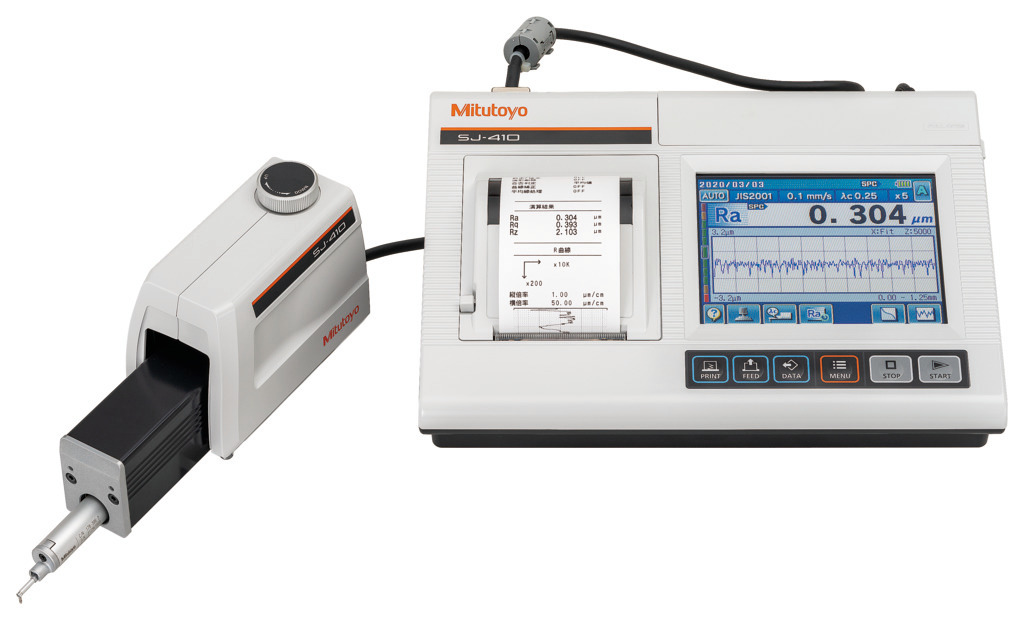
Profilometer / Surface Roughness Tester: Ming-Li Precision’s Mitutoyo SJ-410 for High-Precision Surface Analysis
Introduction
In precision manufacturing, surface quality plays a critical role in determining product performance, durability, and reliability. Even when dimensional tolerances are met, poor surface finish can lead to:
- Increased friction and wear
- Poor sealing performance
- Reduced product lifespan
At Ming-Li Precision Steel Molds Co., Ltd., advanced surface metrology ensures that every component meets strict surface finish requirements. One of the key instruments supporting this capability is the Mitutoyo Surftest SJ‑410, a high-precision profilometer designed for accurate surface roughness evaluation.
What is a Profilometer / Surface Roughness Tester?
A profilometer is used to measure the microscopic texture of a surface, evaluating parameters such as:
- Ra (average roughness)
- Rz (maximum height of profile)
- Rq, Rt, Rp, Rv and many others
These parameters are essential for ensuring:
- Proper sealing performance
- Functional surface interaction
- Compliance with international standards
Mitutoyo SJ-410: High-Resolution Surface Measurement
The Mitutoyo SJ-410 is a portable yet highly advanced surface roughness tester that delivers:
- Wide measuring range up to 800 µm
- Ultra-fine resolution down to 0.0001 µm (sub-nanometer level)
- High-accuracy drive unit with excellent straightness (0.3–0.5 µm)
This level of capability enables Ming-Li Precision to perform extremely detailed surface analysis, even for ultra-fine features.
Key Features and Advantages
1. Ultra-High Resolution Measurement
The SJ-410 offers:
- Resolution down to 0.0001 µm
- Ability to detect extremely fine surface variations
This allows:
✔ Precise control of surface finish
✔ Detection of micro-scale irregularities
2. Skidless & Skidded Measurement Flexibility
The system supports both:
- Skidless measurement (high accuracy, form + roughness)
- Skidded measurement (stable for general surfaces)
This flexibility enables accurate evaluation across different applications.
3. Comprehensive Roughness Parameters
The SJ-410 can evaluate 40+ roughness parameters, including:
- Ra, Rz, Ry, Rt
- Rsk, Rku, Rmr
- Advanced profile and material ratio parameters
This ensures compliance with:
- ISO / JIS / ANSI / VDA standards
4. Advanced Analysis Comparable to Benchtop Systems
Despite being portable, the SJ-410 provides:
- Analysis capability comparable to stationary systems
- Profile analysis and contour evaluation
- Data export via USB for reporting and SPC
5. High Accuracy and Stability
With:
- High-resolution detector
- Precision drive unit
- Excellent straightness performance
The SJ-410 ensures:
✔ Reliable and repeatable measurement results
✔ Consistent quality control in production
Applications at Ming-Li Precision
At Ming-Li Precision, the Mitutoyo SJ-410 is widely used in:
• Mold Surface Finishing Verification
- Checking polishing quality
- Ensuring surface roughness meets design requirements
• Injection Molded Part Inspection
- Measuring surface finish of plastic components
- Ensuring consistency across cavities
• Functional Surface Evaluation
- Sealing surfaces (O-ring grooves, interfaces)
- Sliding and contact surfaces
• Precision Component Analysis
- Evaluating micro-textures and fine structures
- Supporting high-performance applications
Why Surface Roughness Matters
Surface roughness directly affects:
- Sealing performance (leak prevention)
- Friction and wear behavior
- Product durability and reliability
By utilizing the Mitutoyo SJ-410, Ming-Li Precision ensures:
✔ Accurate surface quality control
✔ Improved product performance
✔ Reduced risk of functional failure
Ming-Li Precision’s Quality Commitment
With advanced inspection systems including:
- ZEISS CMM
- ZEISS O-INSPECT optical measurement
- ZEISS optical microscope
- ACCRETECH RONDCOM
- Mitutoyo SJ-410
Ming-Li Precision delivers:
- Sub-micron to nano-level measurement capability
- Comprehensive dimensional and surface inspection
- Reliable, data-driven quality assurance
Combined with expertise in insert molding, 2K molding, and ultra-precision tooling, Ming-Li provides a complete Total Engineering Solution.
Conclusion
The Mitutoyo SJ-410 Surface Roughness Tester enables Ming-Li Precision to achieve ultra-high resolution surface analysis, ensuring that every mold and molded component meets the highest quality standards.
For customers requiring high-performance surface control and precision manufacturing, Ming-Li Precision is a trusted global partner.
Contact Ming-Li Precision
If your project requires:
- Precision mold manufacturing
- Advanced surface roughness measurement
- High-quality injection molding
Ming-Li Precision is ready to support your next project.