
Functional Testing & Validation
Functional Testing & Validation for Precision Molded & Assembled Components
Advanced Functional Testing & Validation for Insert Molded, Overmolded, 2-Shot Molded & Assembled Components
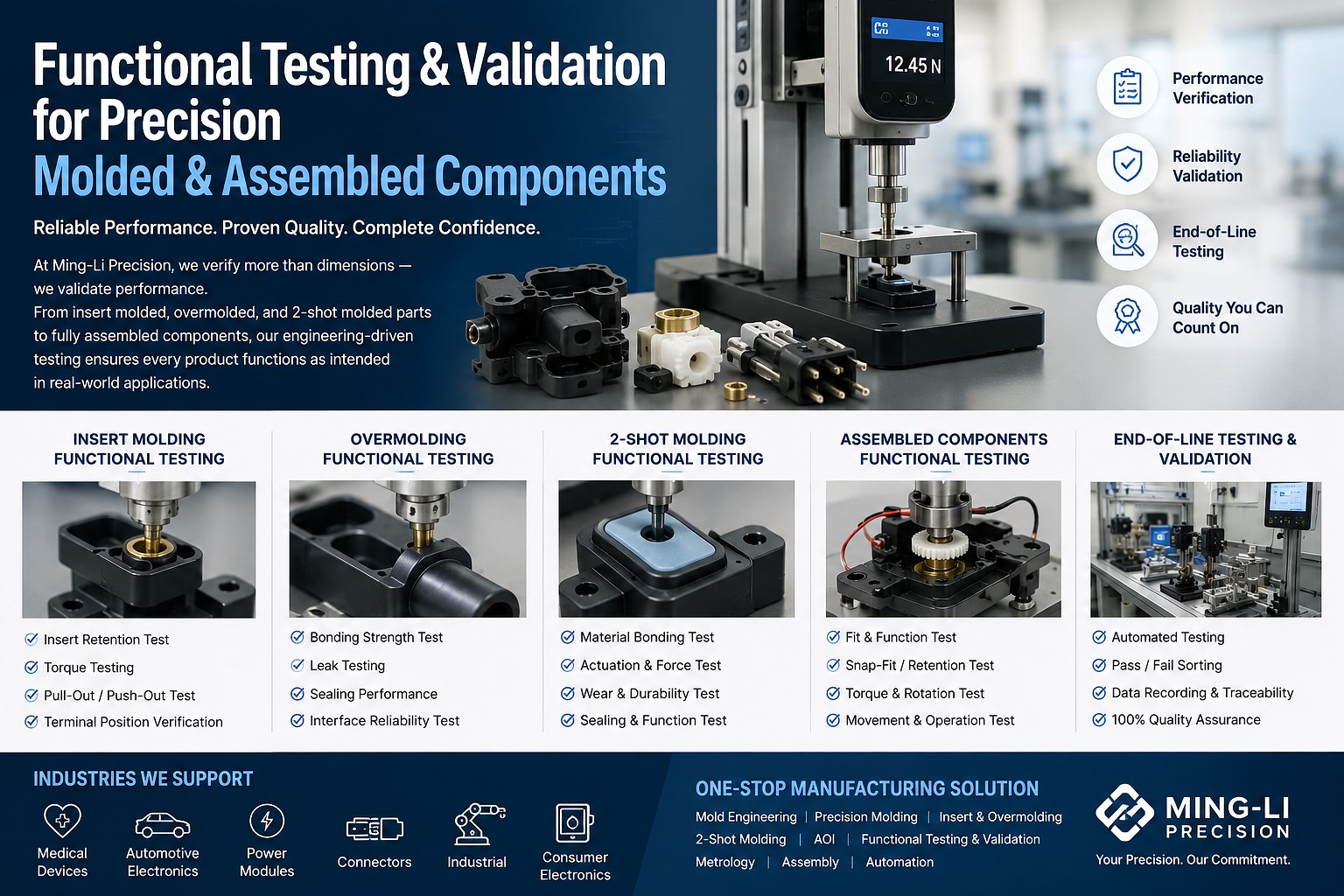
Functional Testing & Validation for Precision Molded & Assembled Components has become increasingly important in high-reliability manufacturing. For insert molded, overmolded, 2-shot molded, and assembled components, dimensional accuracy alone does not guarantee real-world product performance.
At Ming-Li Precision, we verify product performance, assembly reliability, and manufacturing consistency before shipment. Our engineering-driven validation approach helps customers reduce quality risk, improve product reliability, and ensure stable production performance.
Why Functional Testing Matters for Precision Molded & Assembled Components
A dimensionally acceptable component may still experience assembly interference, poor fit, insert instability, bonding inconsistency, leakage, mechanical instability, or performance variation under repeated use.
For medical devices, automotive electronics, power modules, precision connectors, sensors, and industrial products, functional validation is essential to confirm that products perform reliably in real-world applications.
Product Performance
Verify that components and assemblies operate according to intended application requirements.
Assembly Reliability
Confirm fit, alignment, retention, movement, sealing, and interaction between components.
Manufacturing Validation
Support stable, repeatable production quality through testing and process feedback.
What is Functional Testing & Validation?
Functional Testing verifies whether a component or assembly performs according to its intended function. Validation ensures that performance remains consistent, reliable, and repeatable under actual application requirements.
Assembly Function Verification
Confirming correct fit, interaction, and performance between components.
Mechanical Performance Testing
Verification of movement, actuation, retention force, and operational stability.
End-of-Line Verification
Confirming product readiness before shipment with clear pass/fail criteria.
Functional Testing for Insert Molded Components
For insert molded components, functionality extends beyond molded geometry. Successful validation requires verification of insert stability, torque performance, alignment, and mechanical engagement.
Insert Molding Validation
- Insert retention performance
- Torque testing
- Terminal position verification
- Mechanical interface testing
- Pull-out / retention testing
Typical Applications
- Connector components
- Power module housings
- Threaded insert assemblies
- Terminal insert components
- High-reliability industrial parts
Functional Testing for Overmolded Components
For overmolded components, functional performance depends heavily on bonding integrity, sealing performance, and interface reliability between materials.
Bonding Integrity
Confirming stable adhesion between substrate and overmolded material.
Leak Testing & Sealing
Verification of sealing performance for fluid or environmental protection applications.
Interface Reliability
Ensuring stable interaction between materials under operational conditions.
Functional Testing for 2-Shot Molded Components
For 2-shot molded and 2K molded components, validation focuses on material bonding, actuation, sealing performance, wear resistance, and repeatability.
Material Bonding Validation
Verification of adhesion between hard and soft materials.
Actuation Testing
Validation of buttons, tactile features, moving interfaces, and repeated operation.
Sealing & Repeatability
Testing integrated soft-touch, sealing, or flexible functional areas.
Functional Testing for Precision Assembled Components
Beyond molded parts, Ming-Li supports functional testing for assembled components, OEM assemblies, and finished assemblies. These assembled products may include plastic components, metal inserts, terminals, shafts, gears, springs, fasteners, magnets, cables, or other integrated parts.
Assembly Validation
- Fit & function testing
- Snap-fit validation
- Torque & retention verification
- Rotation & motion testing
- Functional assembly verification
Finished Assemblies
- OEM finished assemblies
- Electromechanical assemblies
- Connector assemblies
- Gear and shaft assemblies
- Product readiness verification
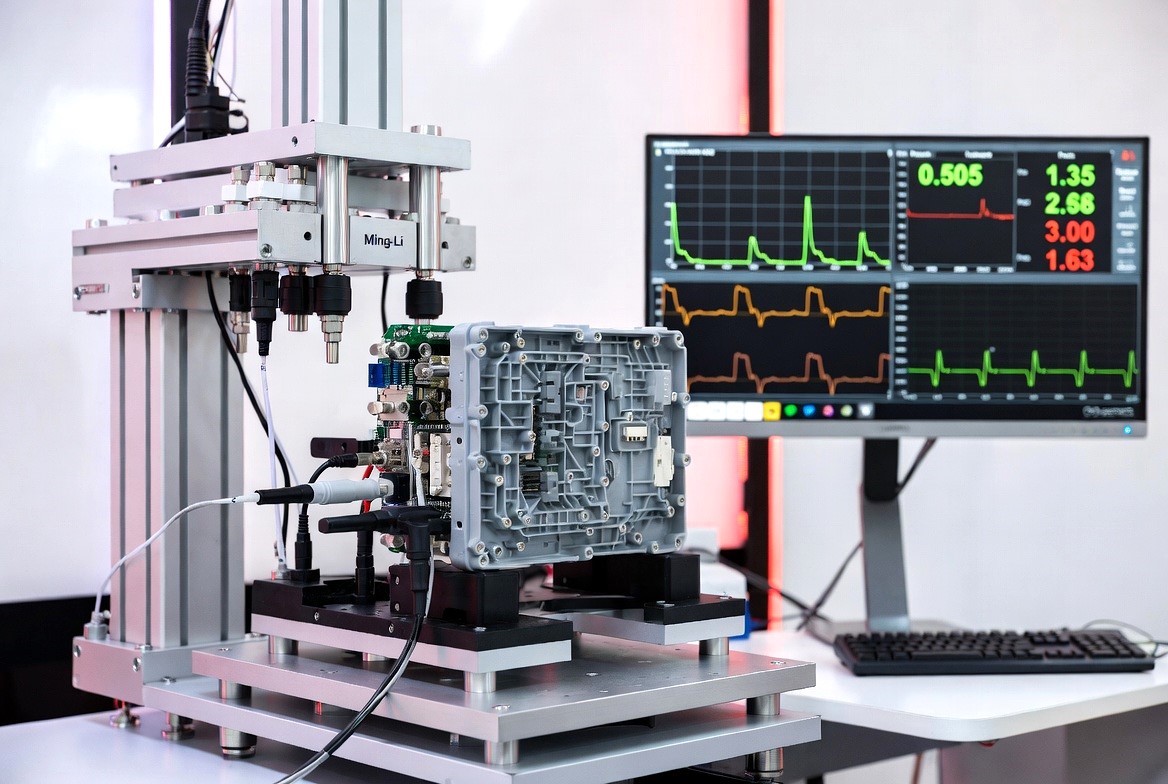
End-of-Line (EOL) Functional Testing & Manufacturing Validation
To improve manufacturing consistency and reduce field failures, Ming-Li can integrate End-of-Line Functional Testing directly into production and assembly workflows.
- Inline functional verification
- Automated assembly validation
- Performance verification
- Pass / fail sorting
- Real-time quality feedback
- Production validation
- Data recording and traceability
- Manufacturing process improvement
Functional Testing + AOI + Precision Manufacturing at Ming-Li
At Ming-Li Precision, quality verification is integrated into our complete manufacturing ecosystem. By combining inspection, functional verification, and engineering validation, Ming-Li helps customers ensure products are not only manufactured correctly, but also perform reliably.
Applications of Functional Testing & Validation
- Medical devices
- Automotive electronics
- Power modules
- Connector components
- Consumer electronics
- Sensor components
- Industrial products
- High-reliability assemblies
Why Choose Ming-Li for Functional Testing & Validation?
Engineering-Driven Verification
Testing methods tailored to product function and real application requirements.
Molding & Assembly Expertise
Strong capability in insert molded, overmolded, 2-shot molded, and assembled products.
Customized Testing Solutions
Functional validation based on actual customer requirements and product application.
Reduced Quality Risk
Identify functional and assembly performance issues before shipment.
One-Stop Manufacturing Integration
From tooling to molding, inspection, testing, assembly, and automation.
High-Reliability Production
Supporting industries requiring stable, repeatable, and validated product quality.
Frequently Asked Questions
What is functional testing for molded components?
Functional testing verifies whether molded components perform according to their intended function, including fit, sealing, movement, retention, and assembly interaction.
Why is functional validation important for insert molded components?
Insert molded components often include terminals, threaded inserts, or metal parts. Validation helps confirm insert retention, torque performance, alignment, and long-term reliability.
How are overmolded components tested?
Overmolded components can be tested for bonding integrity, sealing performance, leak resistance, interface reliability, and mechanical durability.
What testing is used for 2-shot molded components?
2-shot molded components may require material bonding validation, actuation testing, sealing performance verification, wear testing, and repeatability testing.
Can functional testing be integrated into assembly lines?
Yes. Inline verification and End-of-Line functional testing can be integrated into production and assembly workflows.
What is End-of-Line (EOL) testing?
End-of-Line testing verifies product performance before shipment using defined pass/fail criteria, helping prevent defective products from reaching customers.
Looking for Functional Testing & Validation for Precision Molded & Assembled Components?
Whether your project involves insert molding, overmolding, 2-shot molding, precision assemblies, medical devices, power modules, connectors, or high-reliability industrial products, Ming-Li Precision can provide customized Functional Testing & Validation solutions to support stable, scalable, and reliable production.
Contact Ming-Li Precision