
Density Measurement
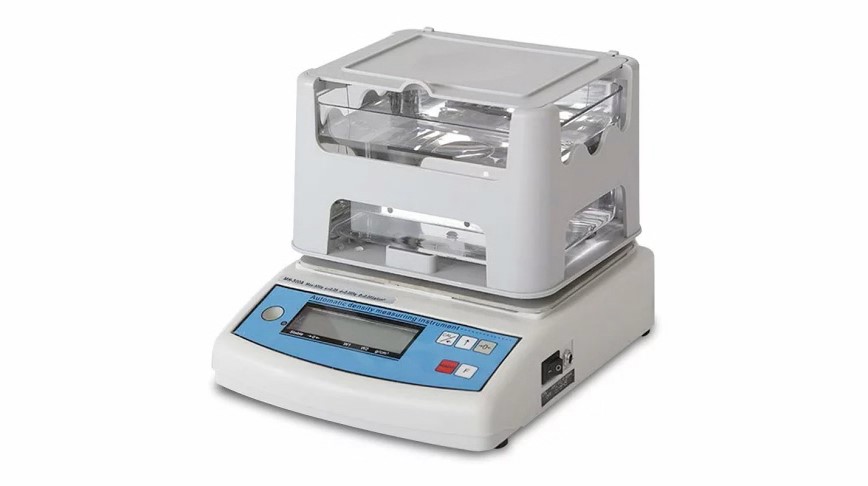
Precision Material Verification: An Introduction to Electronic Density Meters
In high-stakes manufacturing—ranging from automotive power modules to aerospace-grade components—the physical properties of raw materials are the foundation of product reliability. While dimensional accuracy is verified by CMMs, the internal integrity and composition of a material are often validated through density. An Electronic Density Meter is a sophisticated metrology tool designed to provide rapid, high-precision measurements of a substance's density, ensuring that every batch of material meets the rigorous standards required for advanced engineering.
The Science: Archimedes' Principle
The operation of an electronic density meter is primarily based on Archimedes' Principle, which states that any object, wholly or partially immersed in a fluid, is buoyed up by a force equal to the weight of the fluid displaced by the object.
Modern electronic meters automate this process by integrating high-precision weighing sensors with specialized software. The density ($\rho$) is typically calculated using the following formula:
$$\rho = \frac{A}{A - B} \times (\rho_0 - d) + d$$
-
A: Weight of the sample in air.
-
B: Weight of the sample in the auxiliary liquid (usually distilled water or ethanol).
-
Po: Density of the auxiliary liquid.
-
d: Density of air (approximately 0.0012 g/cm³).
Operational Workflow
Unlike traditional manual hydrometers or pycnometers, an electronic density meter streamlines the workflow into a few digital steps:
-
Air Weighing: The dry sample is placed on the upper pan to record its mass in air.
-
Liquid Immersion: The sample is moved to the lower basket and immersed in the liquid. The sensor records the "buoyant" weight.
-
Instant Calculation: The processor instantly factors in the liquid temperature and calculates the density, displaying the result within seconds on a digital screen.
Critical Applications in Precision Manufacturing
In a Total Engineering environment, density verification serves as a vital gatekeeper for quality control:
-
Material Identification and Verification: For high-performance resins such as PEEK, LCP, and PFA, even a slight deviation in density can indicate a mix-up in material grades or the presence of contaminants. This is critical for parts destined for vacuum environments or high-temperature aerospace applications.
-
Detecting Internal Defects (Porosity): In the injection molding process, gas pockets or "voids" can form inside a part. While these may be invisible to the naked eye, a density test will reveal them immediately. If a molded part's density is lower than the raw resin's theoretical density, it signals internal porosity that could compromise structural integrity.
-
Consistency in Metal Die Casting: For components involving die-cast baseplates, density meters ensure that the alloy composition is consistent and that no significant air entrapment occurred during the casting process.
The Advantages of Digital Metrology
Traditional methods are prone to human error and temperature fluctuations. Electronic density meters overcome these challenges through:
-
Temperature Compensation: Many units feature built-in sensors that automatically adjust the calculation based on the current temperature of the liquid.
-
High Resolution: Advanced models can achieve a resolution of 0.001 g/cm³ or higher, necessary for ultra-precision engineering.
-
Versatility: Most units can be reconfigured to measure the density of liquids, powders, and even porous solids by adjusting the software parameters.
As industries push toward miniaturization and higher power densities—specifically in the development of IGBT/SiC power modules—the margin for material error disappears. The electronic density meter is more than just a scale; it is a diagnostic tool that ensures the "DNA" of the material is correct before it reaches the customer. By integrating density verification with ZEISS CMM inspections and MFR testing, manufacturers can offer a truly comprehensive quality assurance protocol.
Electronic Density Meter: Ming-Li Precision’s Capability for Accurate Material Density Measurement
Introduction
In precision manufacturing, material properties are just as critical as dimensional accuracy. Among these properties, material density plays a key role in determining mechanical performance, structural integrity, and product consistency.
At Ming-Li Precision Steel Molds Co., Ltd., comprehensive material verification is part of the company’s advanced quality assurance system. With its Electronic Density Meter capability, Ming-Li ensures accurate and reliable density measurement for a wide range of engineering materials.
What is an Electronic Density Meter?
An Electronic Density Meter is a precision instrument used to determine the density (mass per unit volume) of a material. It typically operates based on the Archimedes principle, measuring the weight of a sample in air and in liquid to calculate its density.
Density measurement is essential for:
- Verifying raw material consistency
- Detecting internal defects such as voids or porosity
- Ensuring correct material composition
Ming-Li Precision’s Density Measurement Capability
Ming-Li Precision is equipped with electronic density measurement systems that provide:
- High-accuracy density determination
- Fast and repeatable measurement results
- Reliable support for both material validation and quality control
This capability is integrated into Ming-Li’s broader inspection and testing workflow, ensuring full traceability from raw material to final product.
Key Features and Advantages
1. High Accuracy and Repeatability
Electronic density measurement systems at Ming-Li deliver:
- Precise mass and volume calculation
- Stable and repeatable results
- Reliable data for quality verification
This ensures consistent material properties across production batches.
2. Detection of Internal Defects
Density measurement is an effective tool for identifying:
- Internal voids
- Porosity
- Material inconsistencies
These defects may not be visible through standard inspection methods but can significantly affect product performance.
3. Material Verification and Quality Control
The system is used to:
✔ Confirm raw material specifications
✔ Verify supplier consistency
✔ Support incoming material inspection
This is especially important for high-performance engineering plastics.
4. Support for Advanced Engineering Materials
Ming-Li Precision applies density measurement to materials such as:
- PEEK
- LCP
- PA, PBT, PC
- Filled or reinforced polymers (glass fiber, carbon fiber)
Density measurement helps ensure:
- Proper filler content
- Consistent material composition
5. Integration with Process Control
Density data can be used to:
- Monitor material drying conditions
- Support injection molding parameter optimization
- Detect material degradation
This contributes to more stable and efficient production processes.
Applications at Ming-Li Precision
• Incoming Material Inspection
- Verifying density against material specifications
- Ensuring supplier quality consistency
• Injection Molded Part Validation
- Detecting voids or internal defects
- Ensuring uniform material distribution
• Engineering Plastic Quality Control
- Monitoring reinforced and high-performance materials
- Supporting high-end applications
• Process Optimization and Troubleshooting
- Identifying issues related to material degradation or moisture
- Supporting root cause analysis
Why Density Measurement Matters
Material density directly impacts:
- Mechanical strength
- Dimensional stability
- Weight consistency
- Product reliability
By implementing electronic density measurement, Ming-Li Precision ensures:
✔ Accurate material verification
✔ Reduced risk of hidden defects
✔ Improved product performance
✔ Consistent manufacturing quality
Ming-Li Precision’s Quality Commitment
With advanced inspection and testing capabilities including:
- ZEISS CMM systems
- Optical measurement systems
- Optical microscopes
- Roundness and form measurement systems
- Surface roughness testers
- Moisture analyzers
- Melt Flow Rate testers
- Electronic density measurement systems
Ming-Li Precision delivers:
- Comprehensive material-to-product quality control
- Data-driven manufacturing processes
- Reliable performance for precision components
Combined with expertise in insert molding, 2K molding, and ultra-precision tooling, Ming-Li provides a complete Total Engineering Solution.
Conclusion
Electronic density measurement is a critical component of modern quality assurance, ensuring that materials meet the highest standards before and during production.
At Ming-Li Precision, this capability strengthens process control, enhances product reliability, and supports the delivery of high-performance precision components.
Contact Ming-Li Precision
If your project requires:
- Advanced material verification
- High-precision mold manufacturing
- Reliable injection molding solutions
Ming-Li Precision is your trusted partner for precision and quality.