
Tensile Testing
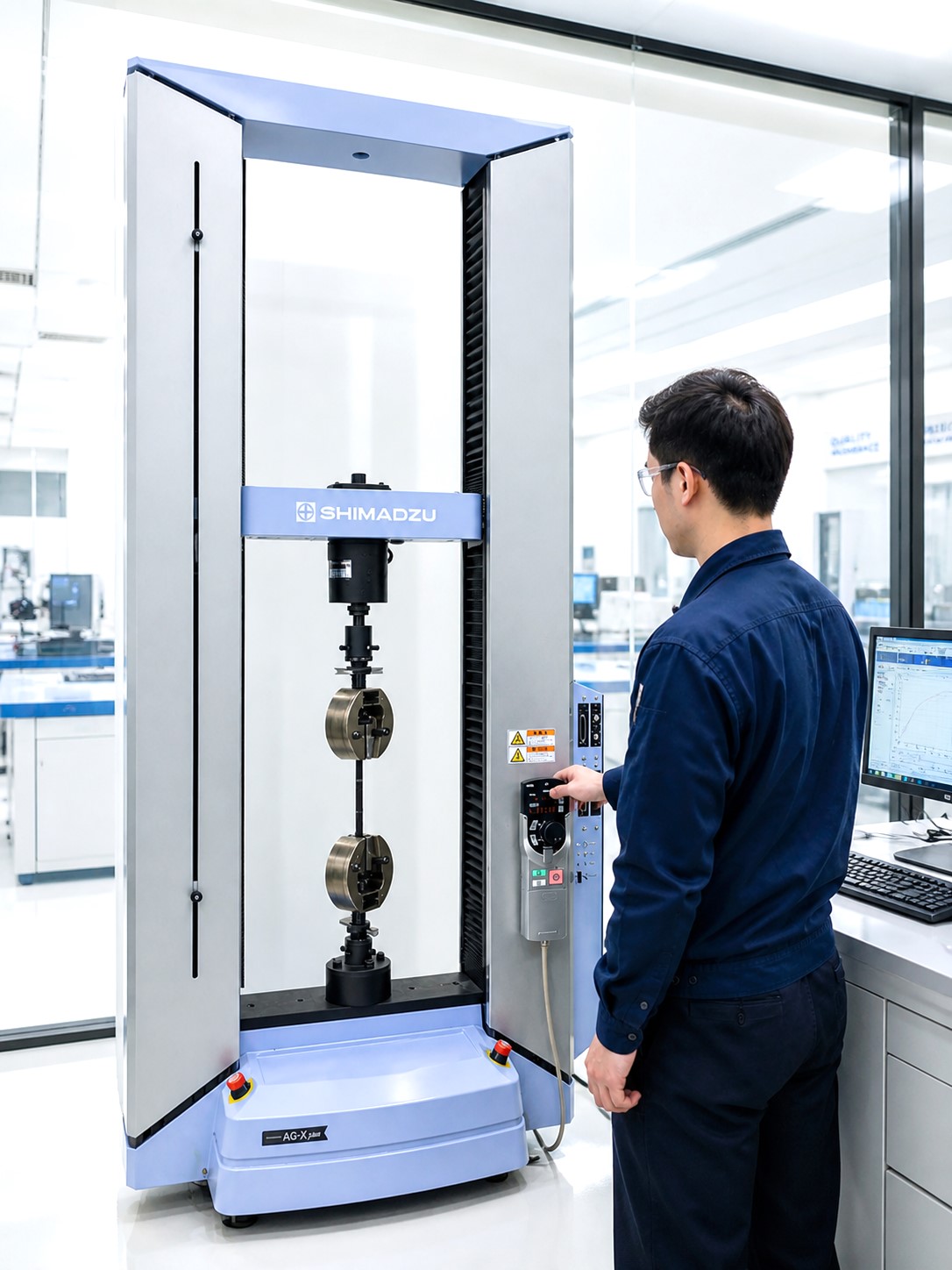
Understanding Universal Tensile Testing: Principles and Applications
Universal Tensile Testing is one of the most fundamental and essential mechanical tests used in material science and engineering. By subjecting a material sample to controlled tension until failure, engineers can determine a wealth of information regarding its strength, elasticity, and durability.
1. The Core Principle
The test is typically performed on a Universal Testing Machine (UTM). A standardized specimen (often shaped like a "dog-bone") is placed between two grips. The machine applies a constant rate of extension, pulling the specimen apart while simultaneously measuring the applied load and the change in length (strain).
2. Key Material Properties Derived
The data collected during the test is plotted on a Stress-Strain Curve, which serves as a "mechanical fingerprint" for the material. From this curve, several critical properties are identified:
-
Tensile Strength: The maximum stress the material can withstand before breaking.
-
Yield Strength: The point at which the material ceases to deform elastically and begins to deform permanently (plastic deformation).
-
Young’s Modulus (Elastic Modulus): A measure of the material's stiffness, calculated from the initial linear slope of the curve.
-
Elongation and Ductility: Indicates how much the material can stretch before it finally fractures.
3. Importance in Modern Manufacturing
Universal Tensile Testing is indispensable across various high-precision industries for several reasons:
-
Quality Assurance: Ensuring that incoming raw materials, such as high-performance polymers (e.g., PEEK, LCP) or specialized alloys, meet the rigid specifications required for aerospace or medical applications.
-
R&D and Material Selection: Helping engineers choose the right material for components that will undergo significant stress, such as automotive structural parts or internal housings for electronics.
-
Failure Analysis: Understanding why a part failed in the field by comparing the actual mechanical properties of the failed component against its design intent.
In an era where miniaturization and extreme performance are the standards, Universal Tensile Testing remains the gold standard for validating material integrity. Whether it is ensuring a plastic component can withstand high-pressure environments or verifying the rigidity of a precision-machined metal frame, this testing method provides the data-driven confidence necessary for global engineering excellence.
Universal Tensile Testing: Ming-Li Precision’s SHIMADZU AG-X Plus for Advanced Material Evaluation
Introduction
In high-precision manufacturing, understanding material behavior under load is essential for ensuring product reliability and performance. Universal tensile testing is one of the most fundamental and critical methods used to evaluate the mechanical properties of materials and components.
At Ming-Li Precision Steel Molds Co., Ltd., advanced testing capability is an integral part of our quality assurance system. Equipped with the SHIMADZU AG-X Plus Universal Testing Machine, Ming-Li provides accurate, reliable, and repeatable tensile testing services to support product development, validation, and mass production.
What is Universal Tensile Testing?
Universal tensile testing evaluates how a material behaves when subjected to tensile (pulling) force. It provides key mechanical properties such as:
- Tensile strength (ultimate strength)
- Yield strength
- Elongation (ductility)
- Modulus of elasticity
- Break point and fracture behavior
These parameters are essential for determining whether a material or component can withstand real-world operating conditions.
SHIMADZU AG-X Plus: High-Performance Universal Testing System
The SHIMADZU AG-X Plus is a high-precision universal testing machine designed for advanced material testing, offering:
- High accuracy load measurement
- Wide testing range for various materials
- Stable and repeatable performance
- Advanced control and data acquisition system
This system is widely used in industries such as automotive, electronics, aerospace, and materials engineering.
Key Features and Advantages
1. High Accuracy and Reliability
The AG-X Plus provides:
- Precise load and displacement measurement
- High-resolution data acquisition
- Excellent repeatability
This ensures that test results are consistent and reliable for critical decision-making.
2. Wide Range of Material Testing
Ming-Li can perform tensile testing on:
- Engineering plastics (PEEK, LCP, PA, PBT, PC)
- Metal components
- Composite materials
- Rubber and elastomers
This flexibility supports a wide range of applications and industries.
3. Advanced Data Analysis and Reporting
The system enables:
✔ Real-time stress-strain curve analysis
✔ Automatic calculation of mechanical properties
✔ Data export for reports and validation
This supports:
- FAI (First Article Inspection)
- Product validation
- Engineering analysis
4. Simulation of Real-World Conditions
Universal tensile testing helps simulate:
- Mechanical loading conditions
- Material deformation behavior
- Failure modes under stress
This allows Ming-Li to identify potential issues before mass production.
5. Custom Fixture and Testing Support
Ming-Li Precision can:
- Develop custom fixtures based on product design
- Adapt testing methods for specific applications
- Support customer-defined test standards
This ensures accurate and relevant testing results.
Applications at Ming-Li Precision
• Injection Molded Parts
- Evaluating strength and elongation
- Ensuring consistent material performance
• Insert Molding Components
- Verifying bonding strength between metal and plastic
- Ensuring structural integrity
• Engineering Material Validation
- Comparing different materials
- Supporting material selection
• Product Development and Failure Analysis
- Identifying weak points
- Improving design and performance
Why Universal Tensile Testing Matters
Without proper tensile testing, products may face:
- Unexpected failure under load
- Reduced durability
- Safety risks
By utilizing the SHIMADZU AG-X Plus, Ming-Li Precision ensures:
✔ Reliable material performance
✔ Accurate mechanical property evaluation
✔ Improved product durability and safety
✔ Reduced risk in real-world applications
Ming-Li Precision’s Engineering Advantage
Ming-Li Precision integrates:
- Precision mold manufacturing
- Injection molding and insert molding expertise
- Advanced metrology and testing systems
- Custom engineering support
This enables Ming-Li to provide a Total Engineering Solution, from material verification to final product validation.
Conclusion
The SHIMADZU AG-X Plus Universal Testing Machine enables Ming-Li Precision to deliver high-accuracy universal tensile testing, ensuring materials and components meet the highest standards of performance and reliability.
For customers requiring precision, consistency, and engineering validation, Ming-Li Precision is a trusted partner.
Contact Ming-Li Precision
If your project requires:
- Material strength testing
- Product validation and analysis
- High-precision manufacturing support
Ming-Li Precision is ready to support your next project with advanced testing and engineering solutions.