
Blog
Automotive Connector with Indicator Light Developed by Ming-Li Precision
Combining Insert Molding and Overmolding for Functional Automotive Components
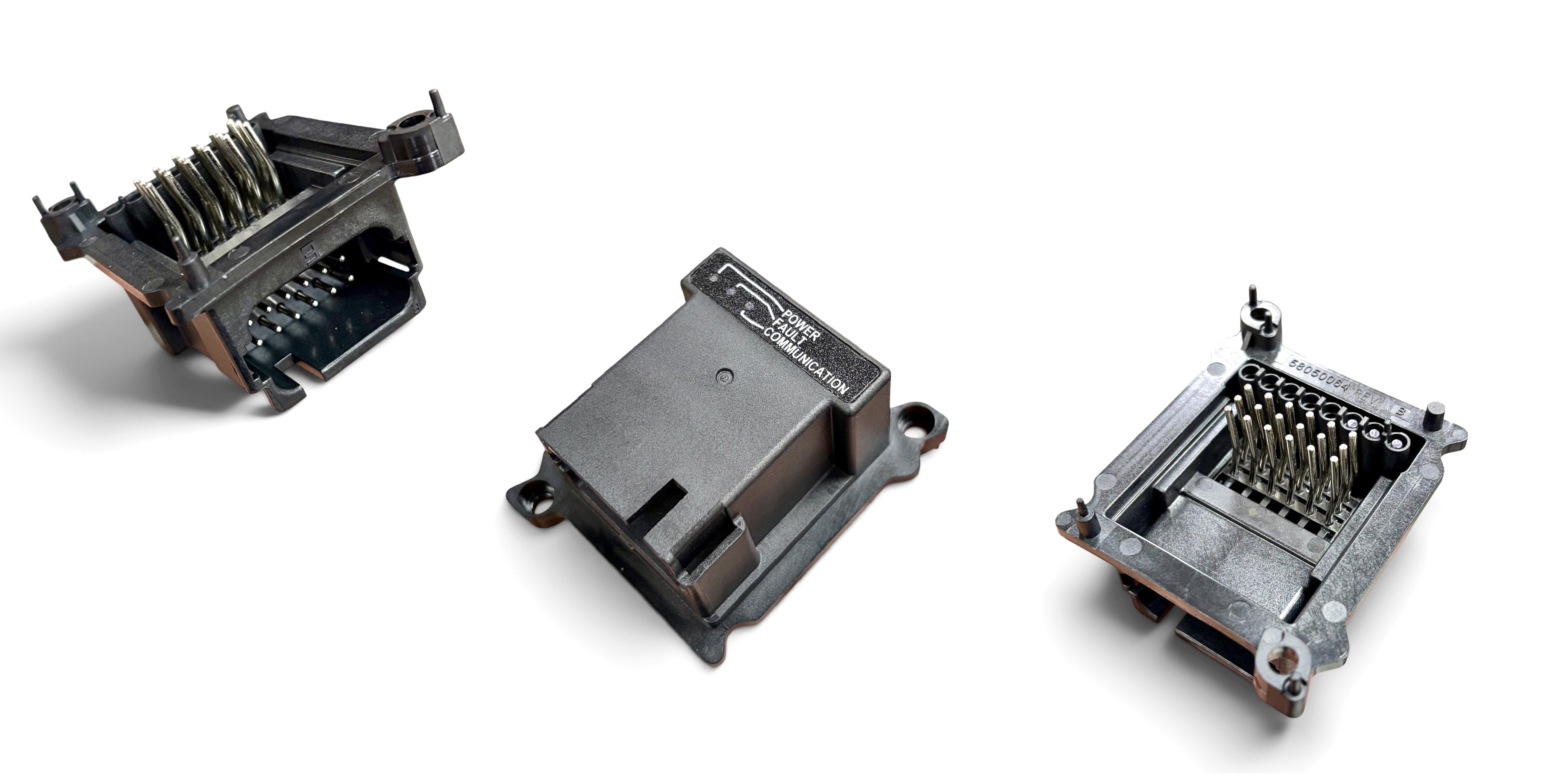
Ming-Li Precision recently supported a customer in the development and manufacturing of a new automotive connector with an integrated indicator light function. This component is not a simple plastic housing, but a functional connector module combining metal pin positioning, transparent light-transmission features, precision molding, overmolding, and final indicator marking.
The product demonstrates Ming-Li’s capability in developing complex automotive plastic components that require both mechanical precision and functional integration.
Product Overview
This automotive connector is designed with multiple metal round pins and transparent molded pins that support indicator light transmission. The final component includes a molded connector body, embedded conductive pins, transparent PA12 round pins, and an indicator marking label for user identification.
Because the part combines electrical connection, light indication, plastic structure, and assembly requirements, the molding process must control several critical factors at the same time:
- Accurate positioning of metal round pins
- Protection of pins during molding
- Stable overmolding around functional inserts
- Proper positioning of transparent PA12 light-guiding pins
- Dimensional stability of the connector body
- Clean appearance for the final indicator area
- Reliable bonding between the first-shot structure and overmolded material
This type of product requires close coordination between mold design, insert positioning, molding process control, and final assembly.
Manufacturing Process
The product is manufactured through a multi-stage process combining insert molding and overmolding.
1. First-Shot Insert Molding for Metal Round Pins
In the first stage, metal round pins are placed into the mold and fixed by injection molding. This step is critical because the pins must remain precisely positioned during the molding process.
Any pin displacement, tilt, deformation, or contamination may affect the final connector performance. Therefore, the mold design must provide stable insert positioning, proper support, and controlled plastic flow around the metal pins.
The objective of the first shot is to create a stable molded sub-component that securely holds the metal pins in the correct position for the next overmolding process.
2. Overmolding with Transparent PA12 Round Pins
After the first-shot component is completed, it is combined with transparent PA12 round pins and placed into the second mold for overmolding.
These transparent PA12 pins act as light-transmission features for the indicator function. During overmolding, the process must maintain the position and cleanliness of the transparent pins while forming the final connector body around them.
This step requires careful control of:
- Insert loading accuracy
- Mold closing protection
- Material flow balance
- Overmolding pressure
- Warpage and shrinkage
- Surface quality around the indicator area
The combination of first-shot metal pin insert molding and second-shot overmolding allows the connector to integrate both electrical and indicator functions into one compact molded component.
3. Final Indicator Marking
After molding, an indicator label is applied to the final component. This marking provides clear visual indication for the connector’s power and communication functions.
The final label application must align with the transparent light-guiding structure and molded surface to ensure both appearance and functional clarity.
Key Technical Challenges
For this type of automotive connector, the main challenge is not only molding the plastic shape, but maintaining functional precision throughout the complete process.
The metal pins must remain stable and undamaged. The transparent PA12 pins must be positioned accurately to support the indicator light function. The overmolded body must provide structural integrity while maintaining dimensional accuracy and appearance quality.
Ming-Li’s experience in mold engineering, insert molding, overmolding, and precision validation helps reduce development risks and support stable production.
Ming-Li’s Engineering Value
This project reflects Ming-Li Precision’s integrated approach:
Mold Engineering
Designing the mold structure, insert positioning system, and overmolding process for stable production.
Insert Molding
Securing metal pins with accurate positioning and reliable plastic encapsulation.
Overmolding
Combining the first-shot molded insert with transparent PA12 pins into a final functional connector body.
Precision Molding Process Control
Managing material flow, shrinkage, warpage, insert protection, and dimensional stability.
Integrated Manufacturing Support
Supporting molding, inspection, marking, and customer-specific production requirements.
Application in Automotive Electronics
Automotive connectors are becoming more complex as vehicles integrate more electronic control systems, sensors, lighting features, and communication modules. Components must not only connect power or signals, but may also need additional functions such as indication, sealing, positioning, or module-level integration.
This connector with indicator light is a good example of how plastic molding technology can support functional integration in automotive electronics.
By combining insert molding and overmolding, Ming-Li helps customers reduce part complexity, improve assembly efficiency, and create more reliable functional components.
Conclusion
The development of this automotive connector with indicator light demonstrates Ming-Li Precision’s ability to support complex molded components from engineering review to production.
Through the integration of metal pin insert molding, transparent PA12 pin overmolding, and final indicator marking, Ming-Li provides a practical manufacturing solution for functional automotive connector applications.
This project also reflects Ming-Li’s core strength:
Mold & Molding as the Core.
Machining and Metrology as the Foundation.
Integrated Manufacturing as the Extension.