
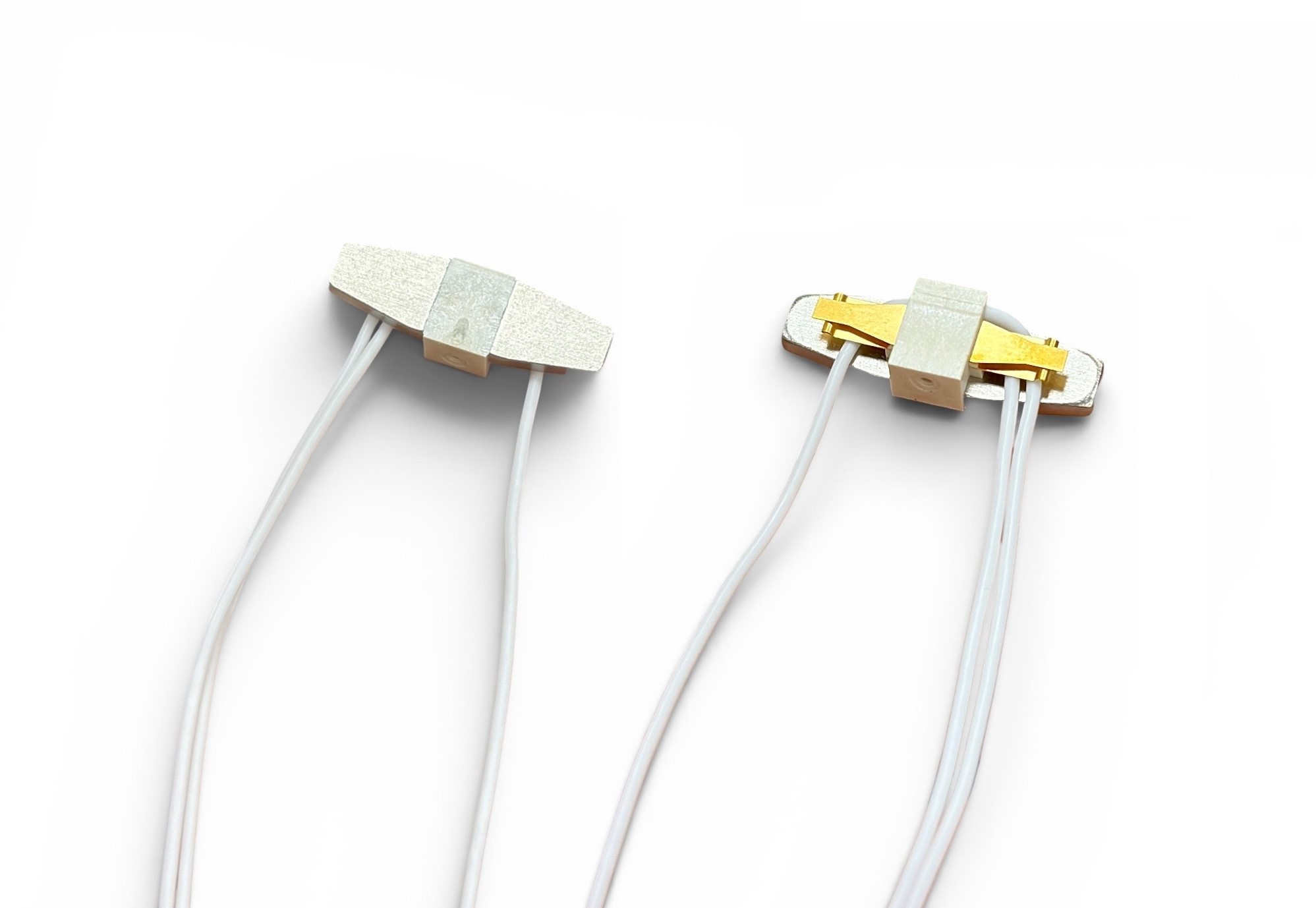
Insert Molding & Overmolding for Microwave Switches
Integrating Powder Metallurgy Inserts, Stamping Inserts, and Wires Using LCP Technology
Ming-Li Precision specializes in insert molding and overmolding technology for high-frequency microwave switch assemblies. By integrating powder metallurgy inserts, stamping inserts, and electrical wires into one compact structure using LCP insert molding, we manufacture high-precision components for signal routing, RF communication, AI testing, optical communication systems, satellite communication, and mmWave applications.
As AI computing, high-speed optical communication, satellite communication, and RF testing continue to advance, microwave systems require stable signal routing, precise switching performance, low signal loss, and highly miniaturized components capable of operating in demanding high-frequency environments.
At Ming-Li Precision Steel Molds Co., Ltd., our advanced insert molding and overmolding capabilities help customers combine metal inserts, powder metallurgy components, stamping contacts, wires, and LCP plastic into reliable microwave switch components for next-generation RF and communication applications.
What Is a Microwave Switch?
A microwave switch is a high-frequency signal switching component used to control signal routing in RF and microwave systems.
Its primary function is to direct microwave or RF signals between different signal paths while maintaining signal integrity and minimizing transmission loss.
Microwave switches are widely used in:
- AI server testing systems
- High-speed optical communication testing
- Data centers
- Satellite communication systems
- Wireless communication infrastructure
- RF testing equipment
- Aerospace communication systems
- 5G and mmWave applications
In modern high-speed communication systems, microwave switches play a critical role in signal routing, enabling engineers to redirect signals quickly and accurately for testing, calibration, validation, and transmission.
Why Insert Molding and Overmolding Matter in Microwave Switches
Traditional microwave switch manufacturing often requires multiple assembly steps involving powder metallurgy components, metal stamping contacts, conductive terminals, electrical wires, and precision plastic structures. However, separate assembly may increase tolerance stack-up, contact inconsistency, signal instability, and manufacturing cost.
Ming-Li Precision utilizes advanced insert molding and overmolding technology to integrate multiple functional components into one compact microwave switch assembly. This approach can help improve component consistency, assembly accuracy, wire retention, and production repeatability.
Powder Metallurgy Inserts for Microwave Switches
Ming-Li Precision integrates powder metallurgy inserts directly into microwave switch structures through powder metallurgy insert molding. These inserts can be used for miniature mechanical functions, switching mechanisms, contact positioning structures, and signal routing mechanisms.
Why Powder Metallurgy Inserts?
Powder metallurgy inserts offer several advantages for compact RF and microwave switch components:
- Excellent dimensional precision
- Complex micro geometry capability
- High wear resistance
- Stable repeatability
- Miniaturized structure capability
By using insert molding, powder metallurgy inserts can be securely integrated into the LCP plastic body, supporting dimensional consistency, mechanical stability, and long-term reliability.
Precision Stamping Insert Integration
In microwave switches, stamping inserts play a key role in electrical signal transmission and switching. Ming-Li Precision integrates ultra-precision metal stamping inserts into the molding process to create electrical contacts, conductive pathways, spring contact structures, and signal transmission terminals.
Stamping Insert Molding Advantages
Compared with traditional assembly methods, stamping insert molding can improve contact stability, reduce tolerance stack-up, and keep micro-scale conductive features accurately positioned inside the molded structure.
For high-frequency switching applications, stable contact positioning is essential because even small variations may affect repeatability, switching behavior, and overall RF signal routing performance.
Wire Overmolding Technology for Microwave Switches
Electrical wires are critical for transmitting switching signals and electrical functions inside microwave switch assemblies. Through advanced wire overmolding, Ming-Li Precision encapsulates electrical wires directly into the component structure.
The benefits of wire overmolding include strong wire retention, stable electrical connection, reduced assembly complexity, and compact product design. Wire overmolding also helps minimize manual assembly operations and supports miniaturized switch structures for high-density RF applications.
When wires, stamping inserts, and powder metallurgy inserts are combined in one insert molding process, precise insert positioning and tooling accuracy become essential. Ming-Li focuses on proper mold design, insert loading control, and stable overmolding conditions to support repeatable production quality.
Why LCP Is Ideal for Microwave Switch Insert Molding
Material selection is especially important for high-frequency microwave applications. Ming-Li Precision utilizes LCP (Liquid Crystal Polymer) for precision insert molding and overmolding of microwave switch components.
Low Dielectric Constant and Low Signal Loss
LCP offers excellent electrical characteristics, including low dielectric constant, low dielectric loss, and stable high-frequency performance. These properties help reduce signal loss in microwave and RF applications.
Excellent Flowability for Micro Structures
LCP enables the molding of ultra-thin sections, fine micro structures, and complex miniature geometries. This makes LCP ideal for compact microwave switch assemblies and micro insert molding applications.
Outstanding Dimensional Stability
Microwave switches require extremely consistent switching performance. LCP provides low shrinkage, excellent dimensional repeatability, and tight tolerance control.
High Thermal Stability
LCP performs reliably in demanding environments involving heat, high-frequency operation, and precision mechanical-electrical integration.
High-Precision Insert Molding for Microwave Switches
Ming-Li Precision combines:
- Powder metallurgy inserts
- Precision stamping inserts
- Electrical wires
- LCP insert molding
- Overmolding technology
to manufacture highly integrated microwave switch components for signal routing applications.
With Ming-Li Precision’s ±1 μm precision tooling capability, we focus on achieving strict flash control in LCP micro insert molding while maintaining stable encapsulation quality for delicate metal contacts, powder metallurgy inserts, stamping inserts, and electrical wire integration.
Microwave Switches for AI and Optical Communication Testing
AI computing and optical communication systems are driving demand for faster and more stable high-frequency testing solutions. Microwave switches can be used to route signals in AI server testing, high-speed optical communication testing, RF test systems, and data center validation equipment.
As transmission speeds continue to increase, stable signal routing becomes increasingly important. High-precision insert molding, LCP molding, stamping insert integration, powder metallurgy insert molding, and wire overmolding can support the miniaturized mechanical-electrical structures required in advanced microwave switch assemblies.
Applications of Microwave Switches
Microwave switch technology is increasingly used in:
AI and High-Speed Data Centers
For high-speed testing, signal routing, and communication validation.
Optical Communication Systems
Supporting ultra-fast signal transmission validation and testing.
Satellite Communication
Including low-earth-orbit (LEO) satellite systems and RF communication modules.
RF Testing Equipment
Used in laboratories and manufacturing testing systems.
5G and mmWave Devices
For advanced wireless communication and high-frequency applications.
Ming-Li Precision's Expertise in Insert Molding and Overmolding
Ming-Li Precision specializes in:
- Insert molding
- Overmolding
- Powder metallurgy insert molding
- Stamping insert molding
- Wire overmolding
- LCP insert molding
- Micro precision molding
- High-precision mold manufacturing
We provide complete engineering support including:
- DFM (Design for Manufacturing)
- Mold flow analysis
- Precision mold design
- Mold manufacturing
- Precision injection molding
- Mass production support
By integrating powder metallurgy inserts, stamping inserts, and electrical wires into one compact structure, Ming-Li Precision delivers reliable and highly integrated microwave switch solutions for next-generation signal routing applications.
FAQ About Microwave Switch Insert Molding
What is a microwave switch?
A microwave switch is a high-frequency signal switching component used to route RF or microwave signals between different signal paths while maintaining signal integrity and minimizing transmission loss.
What is signal routing in microwave switches?
Signal routing refers to directing high-frequency RF or microwave signals from one path to another. In AI, optical communication, RF testing, and data center applications, stable signal routing helps support accurate and repeatable testing.
Why use LCP for microwave switch insert molding?
LCP is suitable for microwave switch insert molding because it offers low dielectric loss, excellent dimensional stability, strong heat resistance, and high flowability for micro structures.
Can powder metallurgy inserts be used in insert molding?
Yes. Powder metallurgy inserts can be integrated into molded plastic structures by insert molding to create compact, precise, and repeatable mechanical or contact-positioning features.
Can stamping inserts and wires be overmolded together?
Yes. Stamping inserts and electrical wires can be overmolded together when proper fixture design, insert positioning, gate design, and process control are applied.
What is the difference between insert molding and overmolding?
Insert molding usually places a metal, wire, or functional insert into the mold before plastic injection. Overmolding generally refers to molding plastic over an existing component or substrate to create an integrated assembly.
Related Technology
- Insert Molding
- Overmolding
- LCP Insert Molding
- Powder Metallurgy Insert Molding
- Stamping Insert Molding
- Wire Overmolding
- Micro Injection Molding
- Precision Mold Manufacturing
Looking for an Insert Molding Partner for Microwave Switch Components?
If you are developing microwave switches, RF signal routing components, or products requiring advanced insert molding, overmolding, powder metallurgy insert integration, stamping insert molding, or wire overmolding, Ming-Li Precision is ready to support your project from DFM and tooling to mass production.
Please contact Ming-Li Precision Steel Molds Co., Ltd. for technical discussion and RFQ support.